





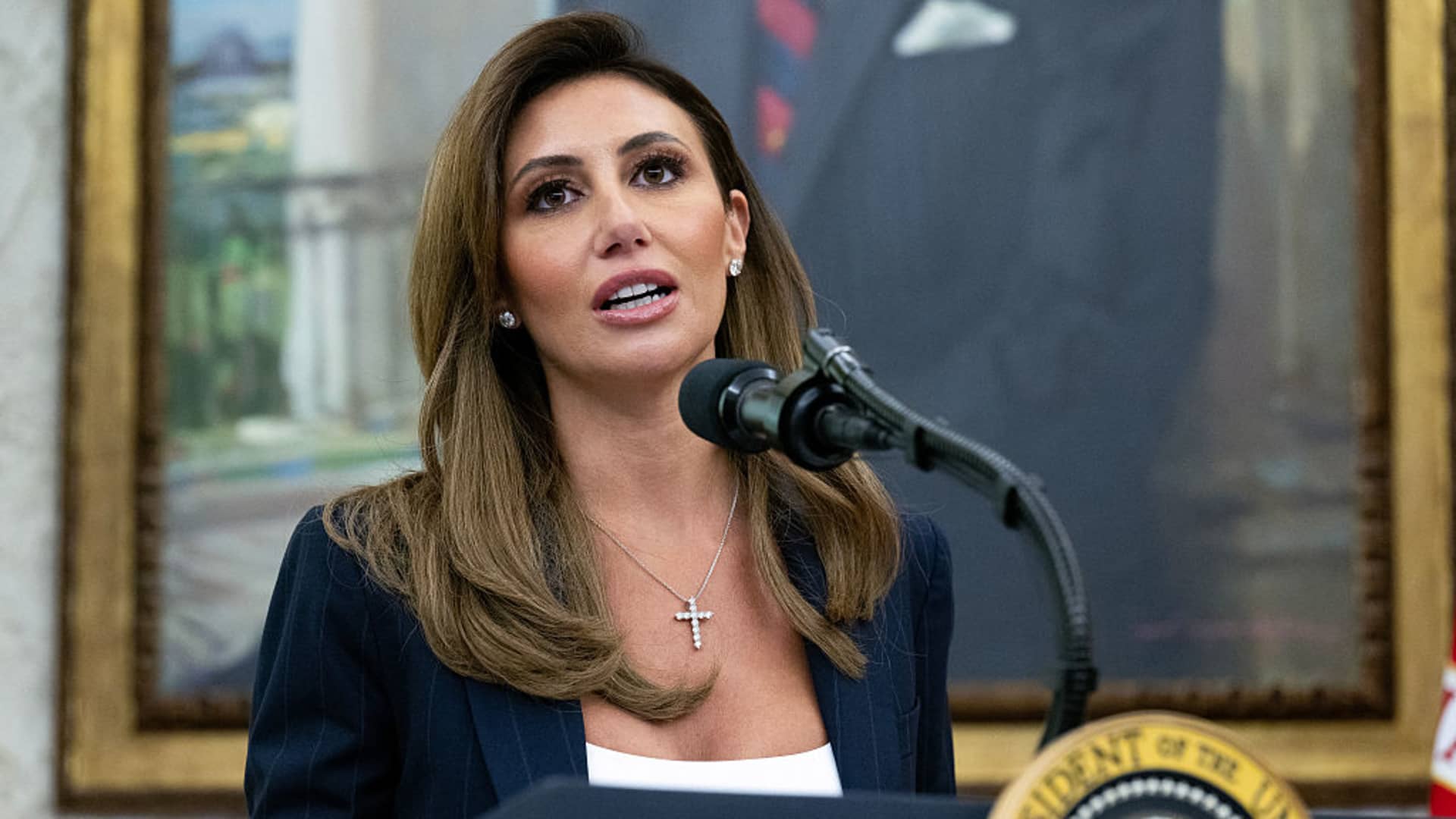
Alina Habba, speaks after being sworn in as US Attorney General for New Jersey, in the Oval Office of the White House in Washington, DC, on March 28, 2025.
Saul Loeb | Afp | Getty Images
Alina Habba, President Donald Trump‘s pick to serve as New Jersey‘s top federal prosecutor, remains disqualified from serving in that role in either a permanent or acting capacity, a U.S. appeals court ruled Monday.
The ruling from the U.S. Court of Appeals for the Third Circuit is the latest judicial rebuke to the Trump administration’s efforts to quickly install its preferred candidates in powerful law-enforcement jobs.
A three-judge panel on that court, in a 32-page opinion, unanimously upheld an Aug. 21 ruling from a lower federal court that Habba was unlawfully serving as acting U.S. Attorney for the District of New Jersey.
“It is apparent that the current administration has been frustrated by some of the legal and political barriers to getting its appointees in place,” Circuit Judge D. Michael Fisher wrote in the appellate ruling.
The unusual series of legal moves taken by the Department of Justice to install Habba, one of Trump’s former personal lawyers, as an acting U.S. attorney demonstrates “the difficulties it has faced,” Fisher wrote.
“Yet the citizens of New Jersey and the loyal employees in the U.S. Attorney’s Office deserve some clarity and stability,” the judge wrote.
Fisher and another judge on the panel, D. Brooks Smith, were nominated to the Third Circuit by Republican former President George W. Bush. The other judge, L. Felipe Restrepo, was nominated by Democratic ex-President Barack Obama.
The judges ruled that Habba’s appointment violated the Federal Vacancies Reform Act, which dictates how vacant government posts can be temporarily filled.
In March, Attorney General Pam Bondi appointed Habba as Interim U.S. Attorney, following the quick resignation of her previous pick. Trump nominated her in June, but she never underwent the Senate confirmation process, a Constitutionally-mandated step that can be lengthy and contentious.
Habba could only legally serve as an interim prosecutor for a limited time under the FVRA. As that deadline neared, the Trump administration took a number of steps to keep Habba in the role.
The DOJ fired Desiree Grace, who was set to become interim U.S. attorney for the district after Habba’s scheduled departure. Trump then withdrew Habba’s nomination, and Bondi appointed her as both “Special Attorney” to the attorney general and the First Assistant U.S. attorney, aiming to elevate her automatically to acting U.S. attorney.
But the appeals court panel ruled Monday that those actions failed to comply with the provisions of the FVRA.
This is breaking news. Please check back for updates.