



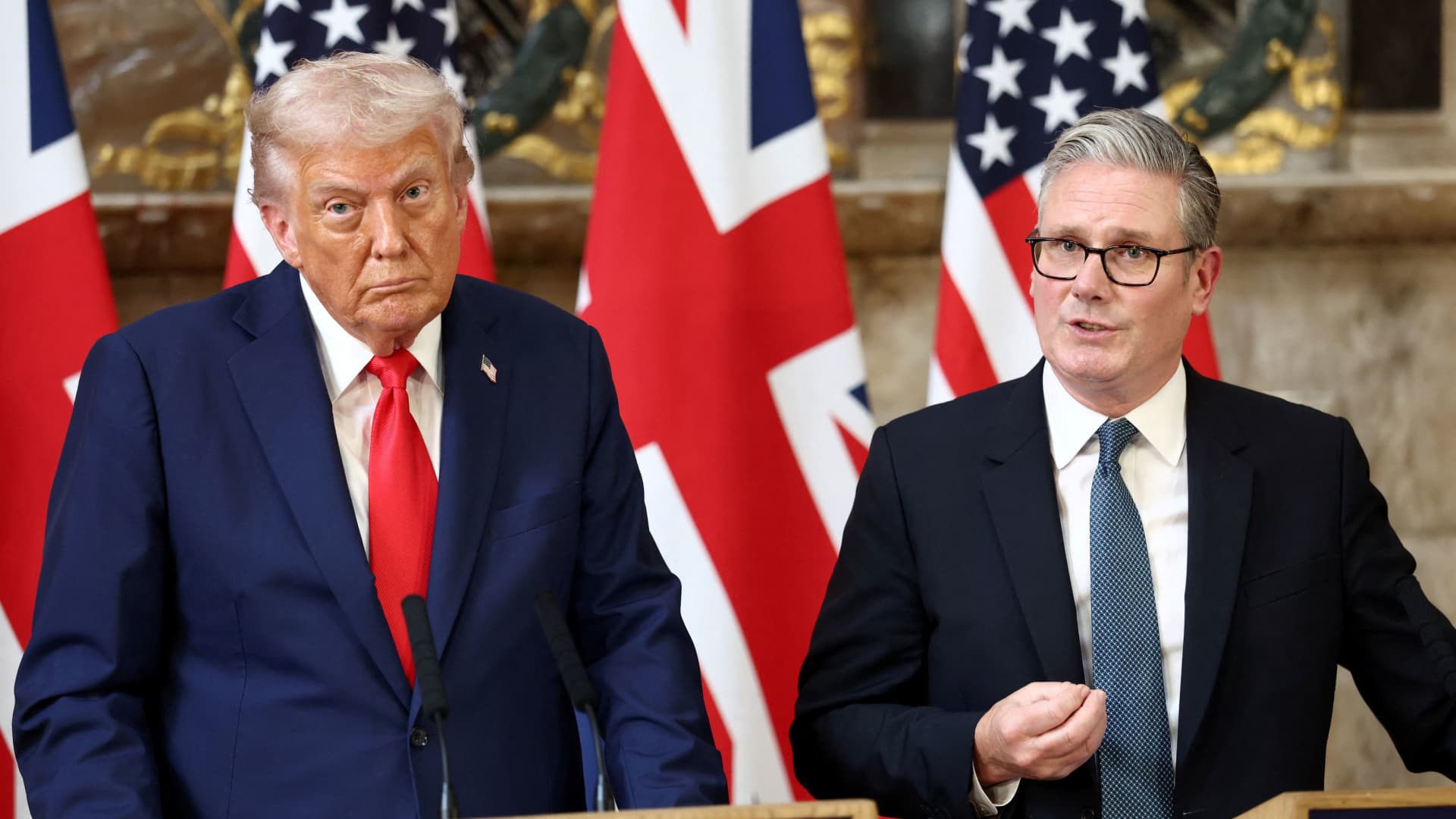
U.S. President Donald Trump and British Prime Minister Keir Starmer hold a press conference following their meeting at Chequers, near Aylesbury, Britain, Sept. 18, 2025.
Kevin Lamarque | Reuters
The United States announced a deal with Britain for zero tariffs on pharmaceutical products and medical technology on Monday which will lead to Britain spending more on medicines.
The deal included an increase in the percentage of the state-run National Health Service (NHS) budget that is spent on medicines.
“The United States and the United Kingdom announce this negotiated outcome pricing for innovative pharmaceuticals, which will help drive investment and innovation in both countries,” United States Trade Representative Jamieson Greer said in a statement.
The office of the USTR statement said that Britain would increase the net price it pays for new medicines by 25% under the deal. In exchange, UK-made medicines, drug ingredients and medical technology would be exempted from so-called Section 232 sectoral tariffs.
Two sources familiar with the deal said it involved a major change in the value appraisal framework at NICE, a UK government body that determines whether new drugs are cost-effective for the NHS, the sources said.
NICE’s “quality-adjusted life year” measures the cost of a treatment for each healthy year it enables for a patient, with the upper threshold being 30,000 pounds ($39,789) per year.
U.S. President Donald Trump has pressed Britain and the rest of Europe to pay more for American medicines, part of his push for U.S. medicine costs to be brought more in line with those paid in other wealthy nations.
The pharmaceutical industry has criticized a tough operating environment in Britain and some major firms have cancelled or paused investment in Britain, including AstraZeneca, the largest firm on the London Stock Exchange by market value.
One point of contention between the sector and the government has been the operation of a voluntary pricing scheme which sees firms put a proportion of sales to the NHS back in to the health service.
The office of the USTR said Britain had committed that the rebate rate would decrease to 15% in 2026.