





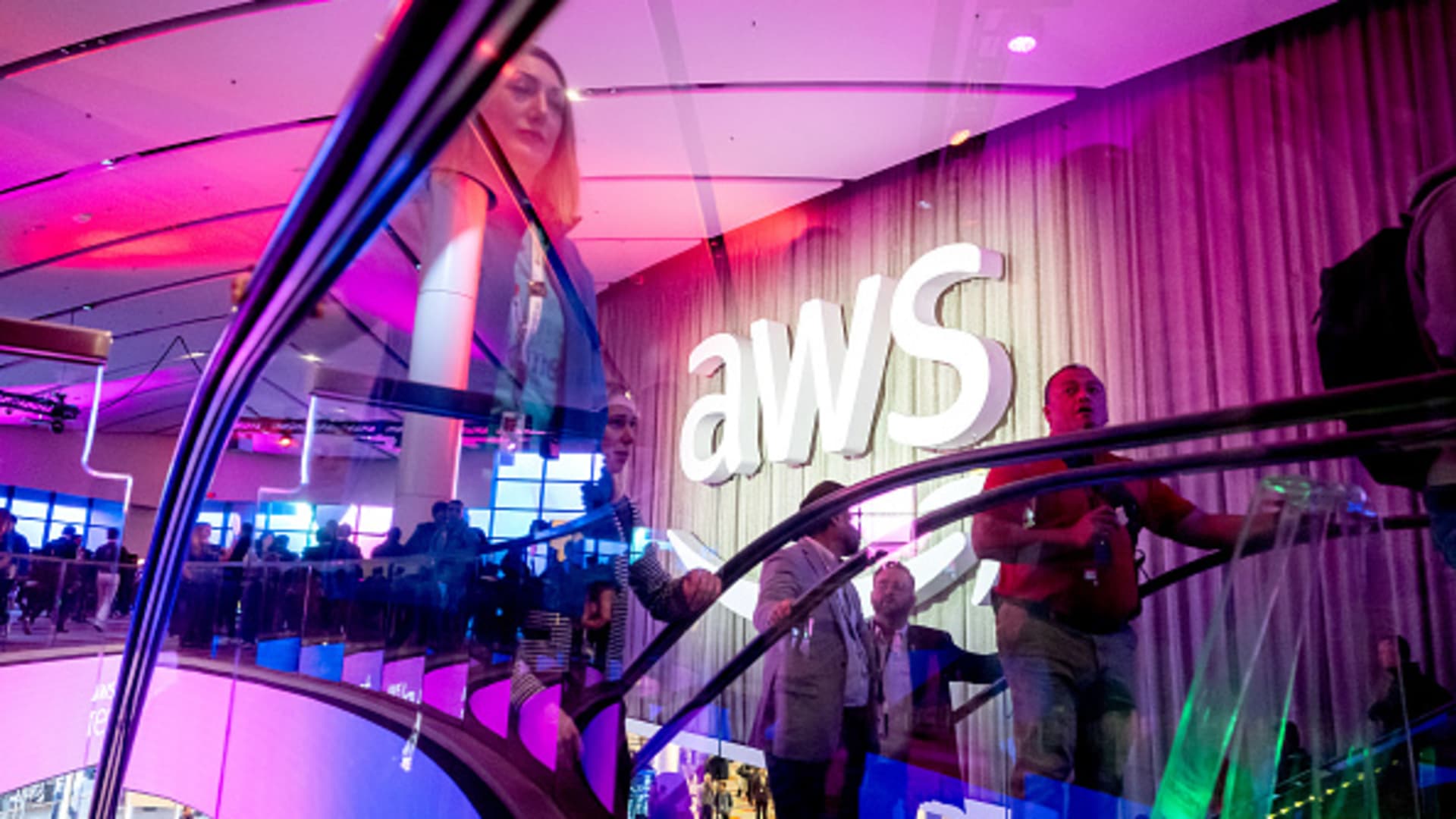
Amazon Web Services’ two-track approach to artificial intelligence came into better focus Tuesday as the world’s biggest cloud pushed forward with its own custom chips and got closer to Nvidia . During Amazon ‘s annual AWS Re:Invent 2025 conference in Las Vegas, Amazon Web Services CEO Matt Garman unveiled Trainium3 — the latest version of the company’s in-house custom chip. It has four times more compute performance, energy efficiency, and memory bandwidth than previous generations. AWS said that early results of customers testing Trainium3 are reducing AI training and inference costs by up to 50%. Custom chips, like Trainium, are becoming more and more popular for the big tech companies that can afford to make them. And, their use cases are broadening. For example, Google’s tensor processing units (TPUs), co-designed by Broadcom , have also been getting a lot of attention since last month’s launch of the well-received Gemini 3 artificial intelligence model. It is powered by TPUs. There was even a report that Meta Platforms was considering TPUs in addition to Nvidia ‘s graphics processing units (GPUs), which are the gold standard for all-purpose AI workloads. At the same time, Amazon also announced that it’s deepening its work with Nvidia. In Tuesday’s keynote, Garman introduced AWS Factories, which provides on-premise AI infrastructure for customers to use in their own data centers. The service combines Trainium accelerators and Nvidia graphics processing units, which allows customers to access Nvidia’s accelerated computing platform, full-stack AI software, and GPU-accelerated applications. By offering both options, Amazon aims to keep accelerating AWS cloud capacity and, in turn, revenue growth to stay on top during a time of intense competition from Microsoft ‘s Azure and Alphabet ‘s Google Cloud, the second and third place horses in the AI race, by revenue. Earlier this year, investors were concerned when second-quarter AWS revenue growth did not live up to its closest competitors. In late October’s release of Q3 results, Amazon went a long way to putting those worries to rest. Amazon CEO Andy Jassy said at the time , “AWS is growing at a pace we haven’t seen since 2022, re-accelerating to 20.2% YoY.” He added, “We’ve been focused on accelerating capacity — adding more than 3.8 gigawatts (GW) in the past 12 months.” Tuesday’s announcements come at a pivotal time for AWS as it tries to rapidly expand its computing capacity after a year of supply constraints that put a lid on cloud growth. As great as more efficient chips are, they don’t make up for the capacity demand that the company is facing as AI adoption ramps up, which is why adding more gigawatts of capacity is what Wall Street is laser-focused on. Fortunately, Wall Street argues that the capacity headwind should flip to a tailwind. Wells Fargo said Trainium3 is “critical to supplementing Nvidia GPUs and CPUs in this capacity build” to close the gap with rivals. In a note to investors on Monday, the analysts estimate Amazon will add more than 12 gigawatts of compute by year-end 2027, boosting total AWS capacity to support as much as $150 billion in incremental annual AWS revenue if demand remains strong. In a separate note, Oppenheimer said Monday that AWS has already proven its ability to improve capacity, which has already doubled since 2022. Amazon plans to double it again by 2027. The analysts said that such an expansion could translate to 14% upside to 2026 AWS revenue and 22% upside in 2027. Analysts said each incremental gigawatt of compute added in recent quarters translated to roughly $3 billion of annual cloud revenue. Bottom line While new chips are welcome news that helps AWS step deeper into the AI chip race, Amazon’s investment in capacity and when that capacity will be unlocked is what investors are more locked in on because that’s how it will fulfill demand. The issue is not a demand issue; it’s a supply issue. We are confident in AWS’ ability to add the capacity. In fact, there’s no one company in the world that could deal with this kind of logistics problem, at this scale, better than Amazon. Amazon shares surged nearly 14% to $254 each in the two sessions following the cloud and e-commerce giant’s late Oct. 30 earnings print. The stock has since given back those gains and then some. As of Tuesday’s close, shares were up 6.5% year to date, a laggard among its “Magnificent Seven” peers, and underperforming the S & P 500 ‘s roughly 16% advance in 2025. (Jim Cramer’s Charitable Trust is long AMZN, NVDA. See here for a full list of the stocks.) As a subscriber to the CNBC Investing Club with Jim Cramer, you will receive a trade alert before Jim makes a trade. Jim waits 45 minutes after sending a trade alert before buying or selling a stock in his charitable trust’s portfolio. If Jim has talked about a stock on CNBC TV, he waits 72 hours after issuing the trade alert before executing the trade. THE ABOVE INVESTING CLUB INFORMATION IS SUBJECT TO OUR TERMS AND CONDITIONS AND PRIVACY POLICY , TOGETHER WITH OUR DISCLAIMER . NO FIDUCIARY OBLIGATION OR DUTY EXISTS, OR IS CREATED, BY VIRTUE OF YOUR RECEIPT OF ANY INFORMATION PROVIDED IN CONNECTION WITH THE INVESTING CLUB. NO SPECIFIC OUTCOME OR PROFIT IS GUARANTEED.