



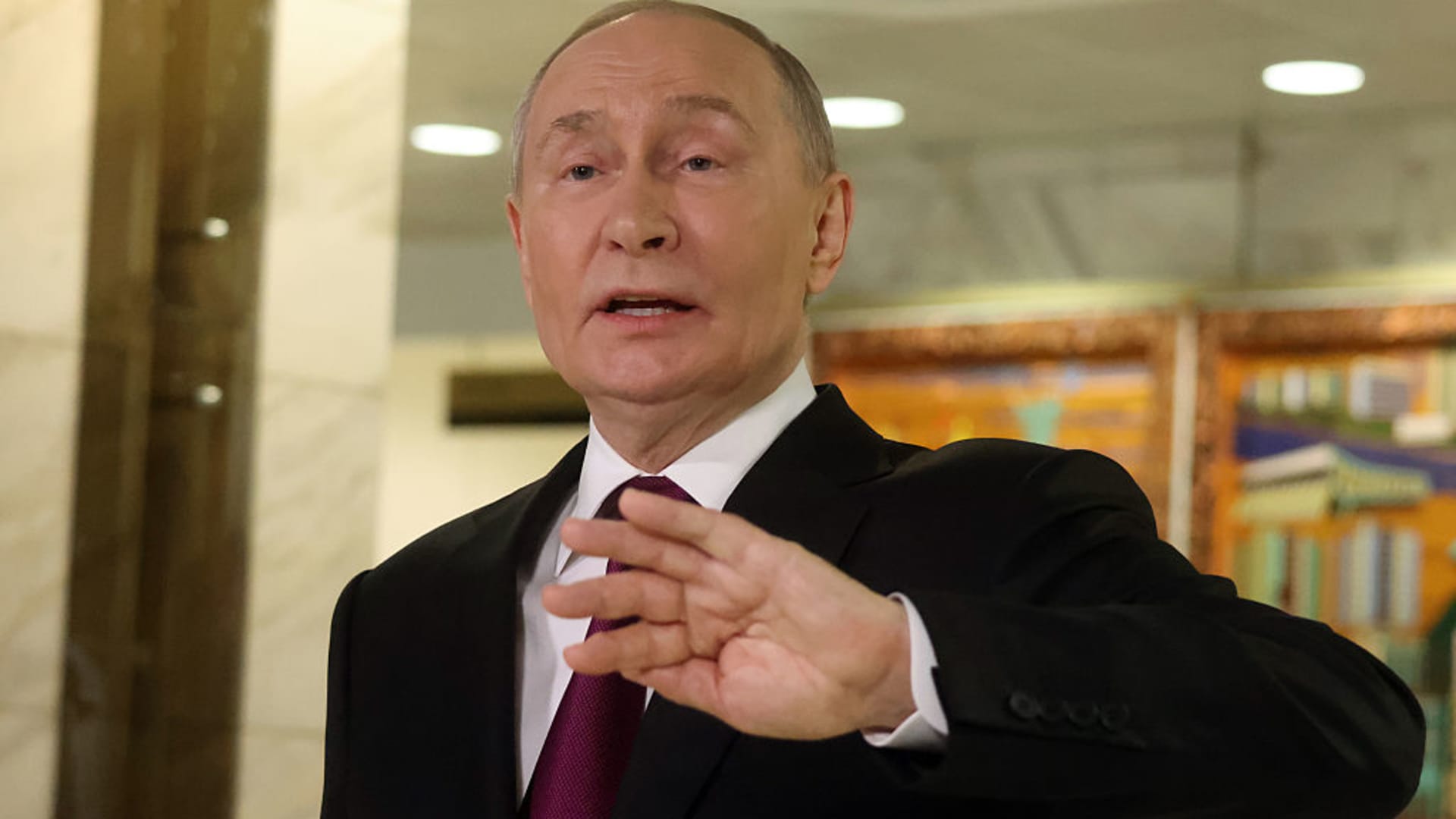
Russian President Vladimir Putin speaks to journalists during his press conference at the VTB Investment Forum ‘Russia Calling!’, on December 2, 2025 in Moscow, Russia. Putin visited an annual forum, hosted by the VTB Group, prior his talk with U.S. special envoy Steve Witkoff.
Contributor | Getty Images News | Getty Images
Peace talks held between the U.S. and Russia on Tuesday failed to deliver a breakthrough with Russian President Vladimir Putin ahead of discussions doubling down on threats toward Europe, saying Russia was “ready” for war with the continent.
U.S. President Donald Trump’s special envoy Steve Witkoff and son-in-law Jared Kushner had traveled to Moscow for talks with Putin and his closest aides on a draft peace plan aimed at ending the almost four-year war in Ukraine.
The talks lasted five hours, Russian presidential aide Yuri Ushakov told reporters after the discussions, saying the meeting focused on a U.S.-drafted peace plan and was “very useful, constructive, and highly informative” but that there was more work to be done.
“We agreed on some things … while others caused criticism, and the President [Putin] also made no secret of our critical, even negative, attitude toward a number of proposals. But the main thing is that we had a very useful discussion,” Ushakov said, in comments translated by NBC News.
It’s unclear which peace plan was presented to the Russians after an initial 28-point peace plan, secretly devised by the U.S. and Russia, was presented to Ukraine a few weeks ago.
Kyiv and its European allies hastily amended that plan, whittling it down to 19 proposals, with Ukrainian officials travelling to Florida last weekend for more talks on the proposals.
Russian President Vladimir Putin at a meeting with U.S. special envoy Steve Witkoff and U.S. President Donald Trump’s son-in-law Jared Kushner at the Kremlin, aimed at finding a solution to end the Ukraine war, in Moscow, Russia on December 2, 2025.
Kremlin Press Office/Anadolu via Getty Images
Russia and Ukraine are miles apart when it comes to central elements of a framework peace agreement, with Moscow demanding that Kyiv cede partially-occupied territory in the east of the country to Russia, and disagreeing over Western-backed security guarantees for Ukraine.
Putin aide Ushakov said Tuesday that both sides had discussed a 27-point plan and had received more documents from the U.S. side, although he did not elaborate as to what those contained. He added that Russia and the U.S. had agreed to not disclose details of the talks.
‘Ready’ for war
The talks in Moscow came after Putin launched a tirade against Europe, saying its counter peace proposals were “absolutely unacceptable” for Russia, and that the region’s leadership had “no peace agenda.”
“We’re not going to war with Europe; I’ve said that a hundred times. But if Europe suddenly wants to fight us and starts, we’re ready right now,” Putin told journalists ahead of his meeting with Witkoff and Kushner.
European officials have expressed consternation in recent weeks that they, and Ukraine, were excluded from initial talks between the U.S. and Russia that led to an original draft peace plan seen to heavily favor Russia.
Russian President Vladimir Putin speaks, as he visits the command post of the Russian forces “West” grouping in the course of Russia-Ukraine conflict, in unidentified location, in this still image taken from video released Nov. 20, 2025.
Kremlin.ru | Via Reuters
EU foreign policy chief Kaja Kallas said Monday that “this week could be pivotal for diplomacy. It is clear that Russia does not want peace, and therefore we need to make Ukraine as strong as possible.”
Europe will have watched Tuesday’s talks in Russia closely. There are concerns that Trump, who has appeared to have a warmer relationship with Putin than with Ukraine’s President Volodymyr Zelenskyy at times, could throw his support behind Russia’s peace proposals in a bid to end the war sooner rather than later.
Eager to appear optimistic over the prospect of peace, Zelenskyy told Irish lawmakers on Tuesday that Ukraine was “closer to peace than ever before” and that there was a “real, real chance” of an agreement after talks with Washington.
No hurry for a deal
Geopolitical experts say the Kremlin is willing to eke out the peace process for as long as possible, with Russia maintaing that it has the advantage on the battlefield and can extract heavy concessions from Ukraine in the peace process.
Michael Froman, president of the Council on Foreign Relations, said it was in Putin’s “interest just to keep the process going, to have a long process of diplomatic engagement.”

“He wants to have a broader conversation about Russia’s reintegration with the West and relations with the United States, commercial agreements with the United States, and to make this long and drawn out while he continues to bomb Ukraine’s energy infrastructure and makes incremental progress on the ground,” he told CNBC’s “Squawk Box” Tuesday.
Amos Hochstein, TWG Global managing partner and former senior advisor to the president in the Biden administration, agreed that Russia would likely drag its heels over a deal.
“I think it’s difficult to get to a point of a deal where a lot of territory has to be given up by the Ukrainians in return for security guarantees that are a bit loose and flimsy, and for the Ukrainians who fought so much over the last several years, that’s hard to swallow,” he told CNBC’s “Squawk Box.”

“I think the problem is that the Ukrainians probably can compromise in some of this, but any concessions they would get from the U.S. on that deal would be difficult to get the Russians to agree to [ as they] depend on the war, want to win, but also have a war economy.”
“The Russians are not in a hurry for a deal here,” he added.