




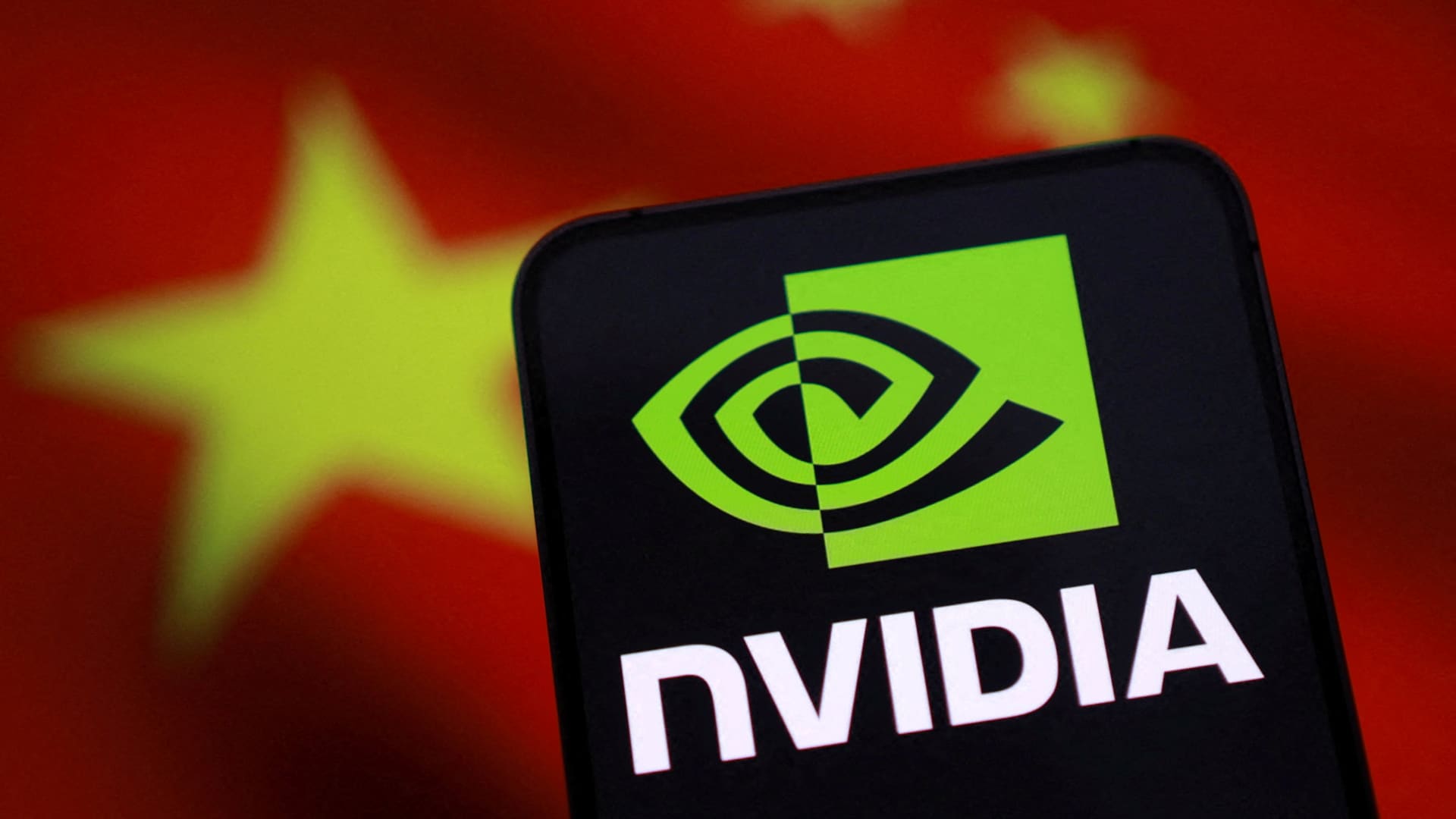
Look at what Nvidia CEO Jensen Huang has said this year, and what Chinese tech giants and Beijing have done, and you’ll see potential hints as to how this lifting of the ban will play out.
Why China might push back against the H200
The H200 is one of Nvidia’s most advanced chips for training and running AI on the market, but China has been on a drive to wean itself off American technology and boost local semiconductor development for AI.
“While this move reopens the door for U.S. revenue, the strategic train has already left the station,” Neil Shah, partner at Counterpoint Research, told CNBC on Tuesday.
Huang said in a Bloomberg interview in May that Chinese tech giant Huawei’s semiconductor products for AI are “probably comparable” to Nvidia’s H200.
Alibaba and Baidu, as well as other Chinese startups, are also racing to bring competitive products to Nvidia to the market.
Huawei has been ramping up its Ascend line of AI products and using massive clusters of chips to try to get performance that is on par with Nvidia.
Huang told CNBC in June that Huawei would have the country’s chip needs covered if Nvidia were never allowed to sell there.
Meanwhile, Alibaba, Tencent and Baidu have been using stockpiled Nvidia chips from before the ban, combined with local semiconductors, to develop models that have become advanced.
Jensen Huang, chief executive officer of Nvidia Corp., departs following a meeting with members of the Senate Banking, Housing, and Urban Affairs Committee in Washington, DC, US, on Wednesday, Dec. 3, 2025. Huang said he’s unsure whether China would accept the company’s H200 artificial intelligence chips should the US relax restrictions on sales of the processors, following a meeting Wednesday with President Donald Trump. Photographer: Graeme Sloan/Bloomberg via Getty Images
Bloomberg | Bloomberg | Getty Images
With China’s drive to self-sufficiency resulting in advanced products, will Beijing want to allow its local companies to buy American products from Nvidia?
“Capability wise, the Chinese ecosystem is catching up fast from semi to stack with models optimized on the silicon and software for significant local consumption,” Shah said. He added that China getting “locked in” to Nvidia chips is a “liability with a hanging sword of political uncertainty.”
“This makes domestic self-sufficiency the only viable long-term strategy for Beijing,” Shah said.
Reasons for China to buy the H200
Trump said Chinese President Xi Jinping “responded positively” to the approval of H200 exports to China.
And while China held off on H20 purchases, there are reasons the country’s companies could want to purchase the H200 product.
The H200 is far more advanced than the H20, which could be tempting for China. Meanwhile, Alibaba CEO Eddie Wu said there were supply shortages across the entire semiconductor supply chain.
“I think there will be demand for H200 as it is a better chip than H20 and there is a shortage of chips in China,” Ben Barringer, head of technology research at Quilter Cheviot, told CNBC on Tuesday. “The big Chinese tech companies will want to use Nvidia and AMD if possible.”
China’s semiconductor industry remains behind that of the U.S. and elsewhere. In particular, China struggles to manufacture the most advanced chips, putting it behind the world’s largest chipmaker Taiwan Semiconductor Manufacturing Co. China is also restricted from buying chipmaking tools that could advance its capabilities.
Meanwhile, domestic alternatives to Nvidia remain behind in performance. This makes Nvidia’s H200 an attractive proposition.
“What is not in China’s favor right now is the supply — ramping up advanced AI chips in terms of performance or yields still remains elusive, making it a less economically efficient push,” Shah said.
“The gap between Nvidia, AMD and Huawei and others is still quite wide when it comes to performance and power efficiency.”
Even if Chinese firms begin buying Nvidia’s product, Beijing’s longer-term trajectory of self-sufficiency will continue.
“In the long run, for the next five to ten years, China’s ‘self-reliance’ strategy for its own tech and innovation won’t change. Jensen Huang of Nvidia has a good time window to sell H200 but it won’t be … forever,” George Chen, partner and co-chair, digital practice, The Asia Group, told CNBC on Tuesday.
“Xi will not be foolish that today Trump can sell H200, and then China just totally relies on U.S. chips. Huawei, Alibaba and other Chinese tech developers remain strategically important for China’s marathon to win the AI race and this will be a long race,” he added.