



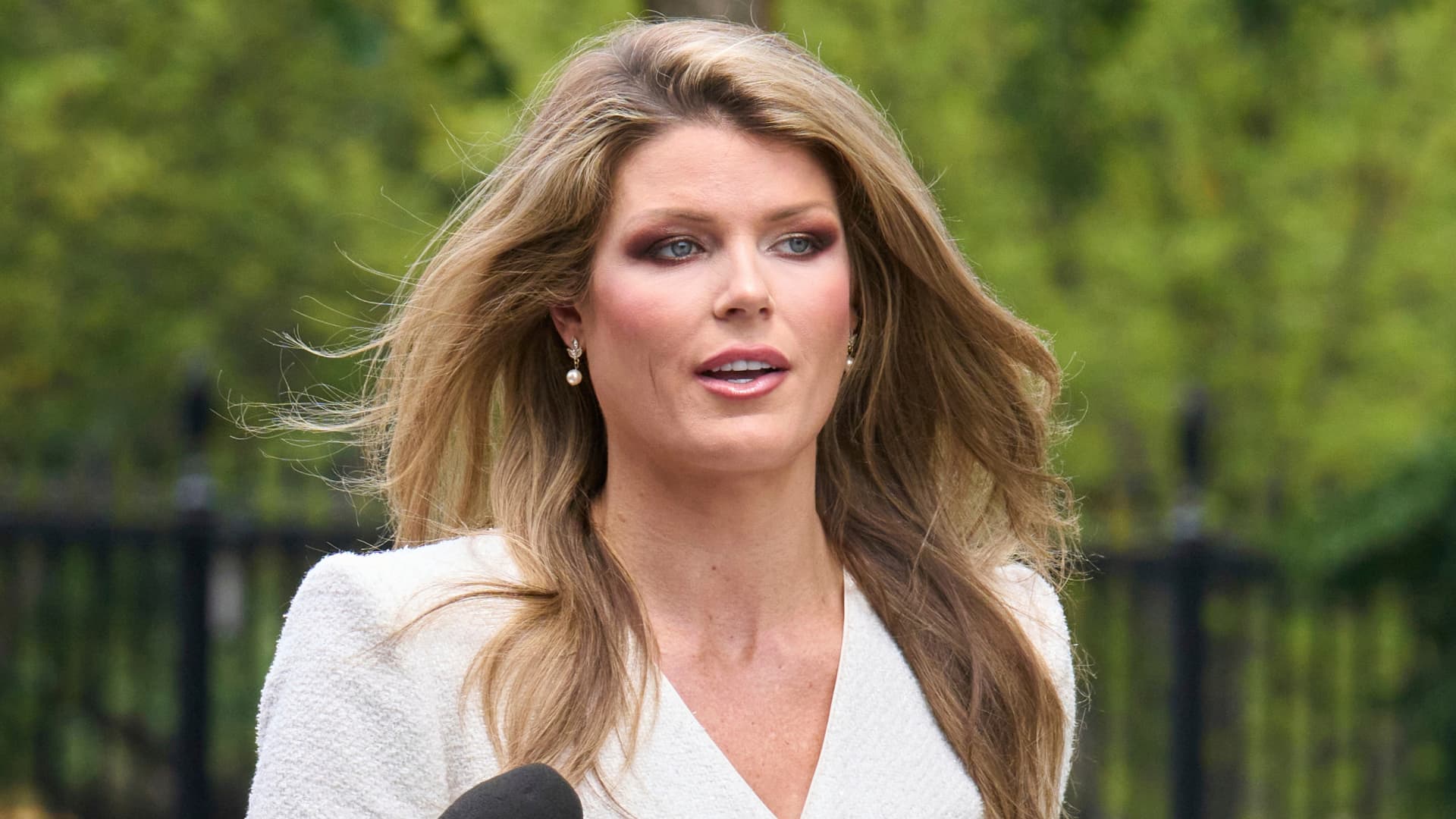
Lindsey Halligan, outside of the White House, Aug. 20, 2025, in Washington.
Jacquelyn Martin | AP
President Donald Trump is pressing to get Lindsey Halligan confirmed as U.S. attorney for the Eastern District of Virginia, weeks after criminal cases against his foes James Comey and Letitia James were dismissed because of Halligan’s involvement in their prosecutions.
But her nomination faces a likely fatal obstacle from the tradition of so-called blue slips, which Republican senators refuse to abandon despite Trump’s demands.
Halligan on Wednesday submitted a 28-page questionnaire to the Senate Judiciary Committee, which is responsible for vetting U.S. attorney picks. It was the first action on her nomination since Trump formally sent it to the Senate on Sept. 30.
The questionnaire was sent more than two weeks after a federal judge disqualified her from serving as interim U.S. attorney for the Eastern District because of the nature of her appointment to that role.
“She’s the president’s nominee. It is our hope that she is confirmed, and submitting her questionnaire is part of that process,” White House press secretary Karoline Leavitt told CNBC.
MS NOW first reported that Halligan had submitted her questionnaire.
A spokesperson for the Judiciary panel’s Republican majority told CNBC in a statement, “The Committee has not received blue slips” from Virginia’s senators, Tim Kaine and Mark Warner, who are both Democrats.
Blue slips — literally forms printed on blue paper — for more than a century have given senators a crucial say over nominees for the judiciary and for U.S. attorneys in their states.
“Nominees without blue slips don’t have the votes to advance out of committee or get confirmed on the Senate floor,” the Judiciary spokesperson said.
Judiciary Chairman Chuck Grassley, R-Iowa, has called the practice “a fundamental example of our system of checks and balances” that “prevents one party from jamming through nominees who don’t align with the values in the communities they would serve.”
The Judiciary spokesperson said that Grassley “wants President Trump’s nominees to be successful.”
Halligan had no prior prosecutorial experience when Trump tapped her to lead the U.S. Attorney’s Office.
Instead, her legal career largely focused on insurance cases.
She previously worked as a lawyer for Trump on a federal criminal case in Florida, where he was accused of illegally retaining classified documents, and on Trump’s defamation case against CNN.
Trump has repeatedly urged Republicans to abandon the blue slips rule, arguing that it undermines his ability to confirm his preferred candidates for key roles.
On Thursday morning, the president complained that the practice is “making it impossible to get great Republican Judges and U.S. Attorneys approved to serve in any state where there is even a single Democrat Senator.”
“If they say no, then it is OVER for that very well qualified Republican candidate,” Trump wrote on Truth Social.
His post called out Grassley by name for allowing the “scam” to continue.
Trump also urged Senate Majority Leader John Thune, R-S.D., “to get something done, ideally the termination of Blue Slips.”
Alina Habba, another former Trump lawyer whom he picked to lead the U.S. Attorney’s Office in New Jersey, early this week quit that post, blaming the “flawed blue slip tradition” as part of her decision.
Habba likewise had previously been disqualified by a judge from serving as the temporary head of the office because of the nature of her appointment.
Attorney General Pam Bondi appointed Halligan as interim U.S. attorney for the Eastern District of Virginia on Sept. 20, a day after the prior interim top prosecutor, Erik Siebert, resigned under pressure from Trump.
Days later, Halligan presented evidence to a federal grand jury, which indicted Comey on charges of making false statements to Congress and obstructing a congressional proceeding.
In mid-October, Halligan obtained another grand jury indictment, against James, the attorney general of New York state, for allegedly filing false claims on mortgage records.
Comey and James have denied any wrongdoing.
On Nov. 24, senior U.S. District Judge Cameron Currie dismissed both criminal cases, saying that Halligan’s appointment was “defective” and that any action flowing from her appointment “must be set aside.”
Currie ruled that Halligan’s installation violated a statutory mechanism for appointing interim U.S. attorneys.