



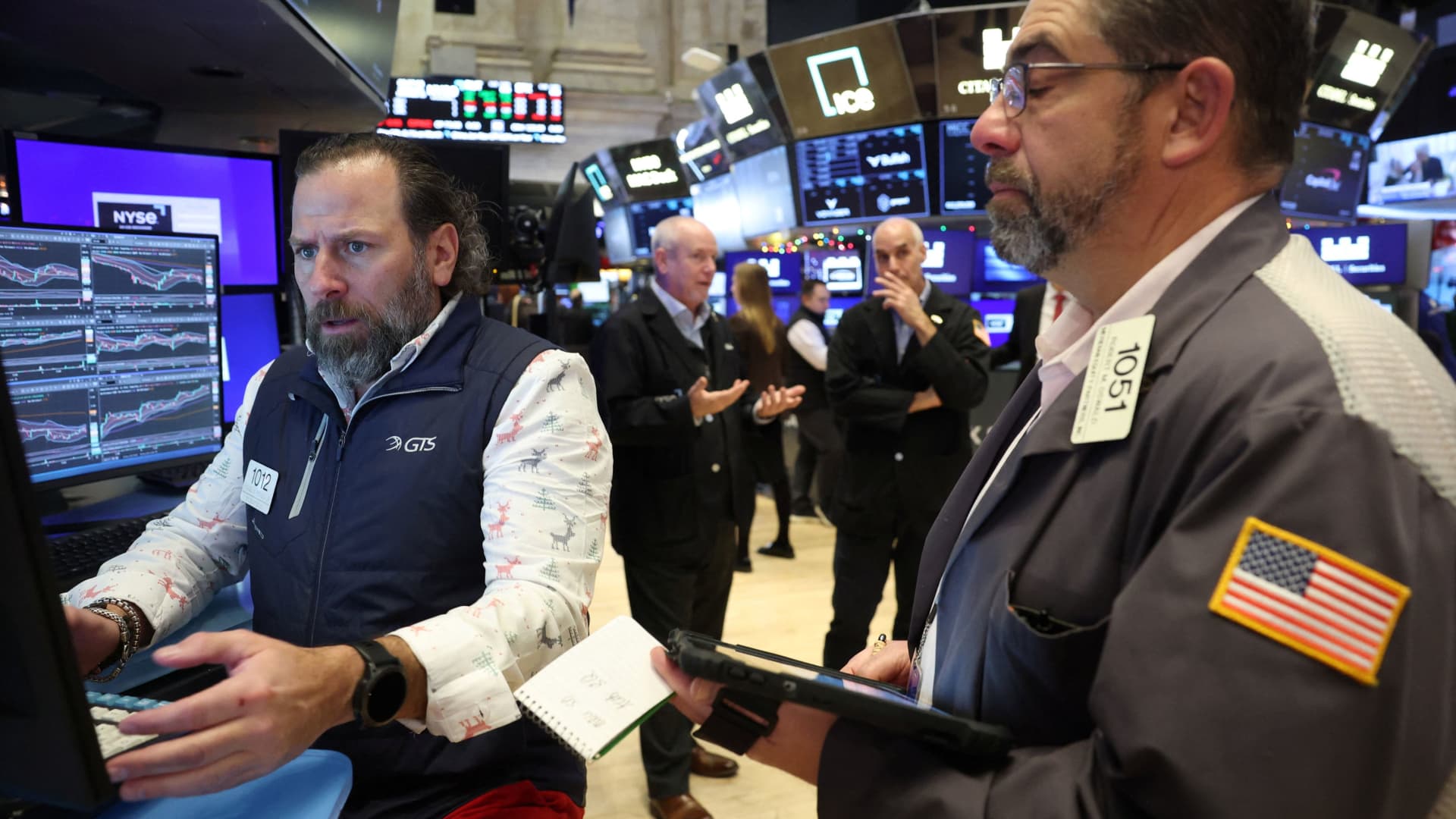
(These are the market notes on today’s action by Mike Santoli, CNBC’s Senior Markets Commentator.) The market remains caught in the opposing currents of AI anxiety and economic enthusiasm. Friday, the AI pressure proved a bit too heavy for the economically sensitive parts of the market to absorb fully, leaving the S & P 500 working on a modest weekly loss. It remains a pro-cyclical rotation under the surface, with value outperforming growth, equal-weight S & P 500 down less than the headline index and bank stocks holding up fairly well. Yet, for as resilient as the tape has been – the S & P 500 making its first new closing high in six weeks Thursday by a few points – the chart is taking on a bit of a stuck appearance. The index traded down Friday to levels first reached on Oct. 24. The uptrend remains in place, for sure, even as the index churns under 6900. As shown, and as often happens, the lower end of the breakout range is intersecting with the 50-day moving average about 1% down from here. The retreat from the expensive, enormous AI plays that propelled the indexes for half a year has been underway for more than a month, with the Nasdaq-100’s dominance over the median stock having peaked around Election Day. Broad misgivings about the pace of AI investment, the vast capital needs for data centers, the shifting advantages among model developers and questions over aggressive debt financing were exacerbated in recent days with results from Oracle and Broadcom and those companies’ inability, for now, to reassure investors that buildouts remain well-considered and on track. For the many investors who believed the market had grown too concentrated in Magnificent 7 -type stocks, this switchback in leadership is likely welcome. But just yesterday I offered this cautionary observation : “As I always point out, a broader market is not a safer or more stable one. Rotations out of the Mag7 – which collectively are 35% of the S & P 500 – can grow disorderly without much warning. And leadership by Old Economy sectors will run into valuation concerns more quickly than the open-ended, moon’s-the-limit AI plays.” Friday’s wobble doesn’t yet suggest anything alarming in terms of market stress. It remains for now a slightly ragged rotation. The seasonal-pattern watchers will also note that a soft patch for stocks in the first half of December is not unusual, even in years when the indexes go on to levitate into year end. The Treasury market continues to reprice in response to the Federal Reserve’s quarter-point rate cut, pledge to buy short-term debt to stabilize money markets and some dovish-seeming commentary about the 2026 interplay of economic growth, productivity and rates. The 10-year note yield is above 4.19%, around a three-month high. It remains well shy of levels that have unnerved equity markets in recent years (4.5% or so) while arguably conveying expectations of a potential pickup in economic growth. Next week some delayed and consequential economic data will drop into a late-December, pre-holiday trading environment. With a divided Fed and active debate among economists about the weighting of macroeconomic risks, we’ll get November employment data and CPI, which could well change some minds. Bitcoin continues to trade heavy, looking wounded after a flash liquidation event two months ago. This continues to suppress risk appetites among active retail traders at least relative to the feverish action of the late summer and early fall. Robinhood shares, down almost 9% this week, are 20% below their high (though have still tripled this year). More broadly, investors are in a pretty upbeat mood. Bank of America’s Bull & Bear Indicator recently jumped into the “extreme bull” zone which has coincided with some pretty good tactical market tops in recent years. Though it’s not flawless: A similar reading came in December 2020, and the market continued to stampede higher led by speculative, risky stocks, until that group hit a buying climax several weeks into the new year.