



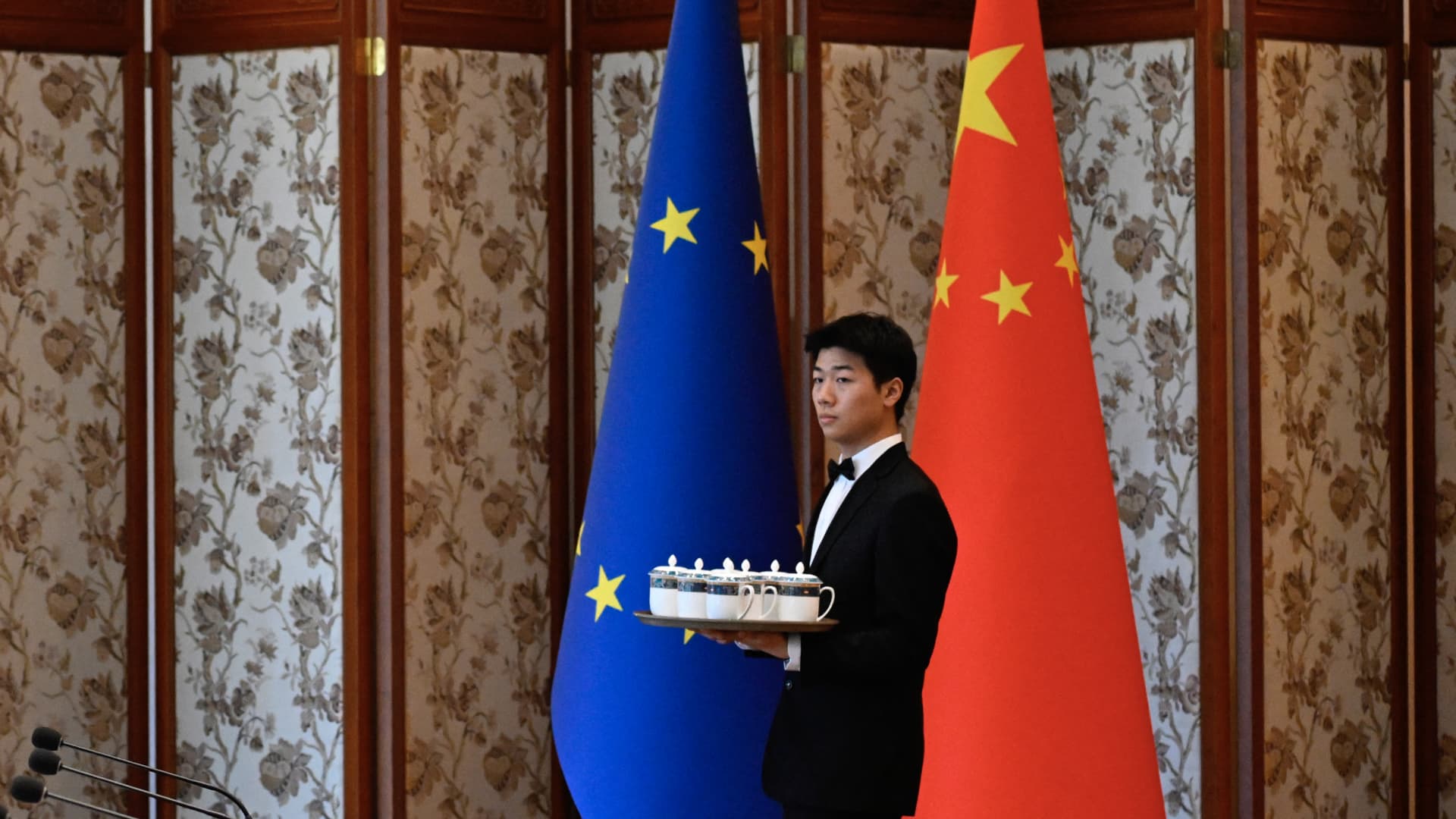
A staff member prepares for the arrival of Chinese Vice Premier Ding Xuexiang and EU Executive Vice-President for a Clean, Just and Competitive Transition, Teresa Ribera during China-EU Sixth High Level Environment and Climate Dialogue (HECD) at the Diaoyutai State Guest House in Beijing on July 14, 2025.
Wang Zhao | Afp | Getty Images
China on Tuesday announced lower duties on pork imports and pig by-products from the European Union as it concluded a year-long anti-dumping investigation into European pork imports.
The new tariff rates — ranging from 4.9% to 19.8% on dozens of European pork exporters — will start taking effect on Wednesday and last five years, according to the Chinese commerce ministry.
Earlier in September, China had imposed temporary anti-dumping tariffs of up to 62.4% in the form of cash deposits on pork imports from the EU.
The trade tensions had flared after Brussels slapped tariffs of up to 45% in October last year on electric vehicles imported from China, drawing Beijing to denounce it as protectionist.
China launched the anti-dumping probe in June last year as part of a countermeasure to the EU’s punitive measures against its EV sector.
The EU is the world’s largest pork exporter, selling around 13% of its annual production overseas, with China being the single largest buyer, according to estimates by S&P Global.
European leaders have called out Beijing’s growing trade imbalance with major trading partners, including the EU, as tariff tensions with Washington propelled Chinese exporters to redirect shipments to non-U.S. markets.
China’s trade surplus reached a record of more than $1 trillion for the year as of November.
Beijing’s curbs on rare earth exports had also threatened a shortage of the critical minerals at several European manufacturers that sought to diversify supply chains from China. The agreement that China struck with the U.S. in late October has allayed some concerns, as Beijing reportedly has started granting licenses for such exports.
The EU and China have also clashed over the export of semiconductors after the Netherlands took control of Nexperia, a Chinese-owned firm based in the country. Last week, Beijing called on the Dutch government to send a delegation to China for further negotiations.