



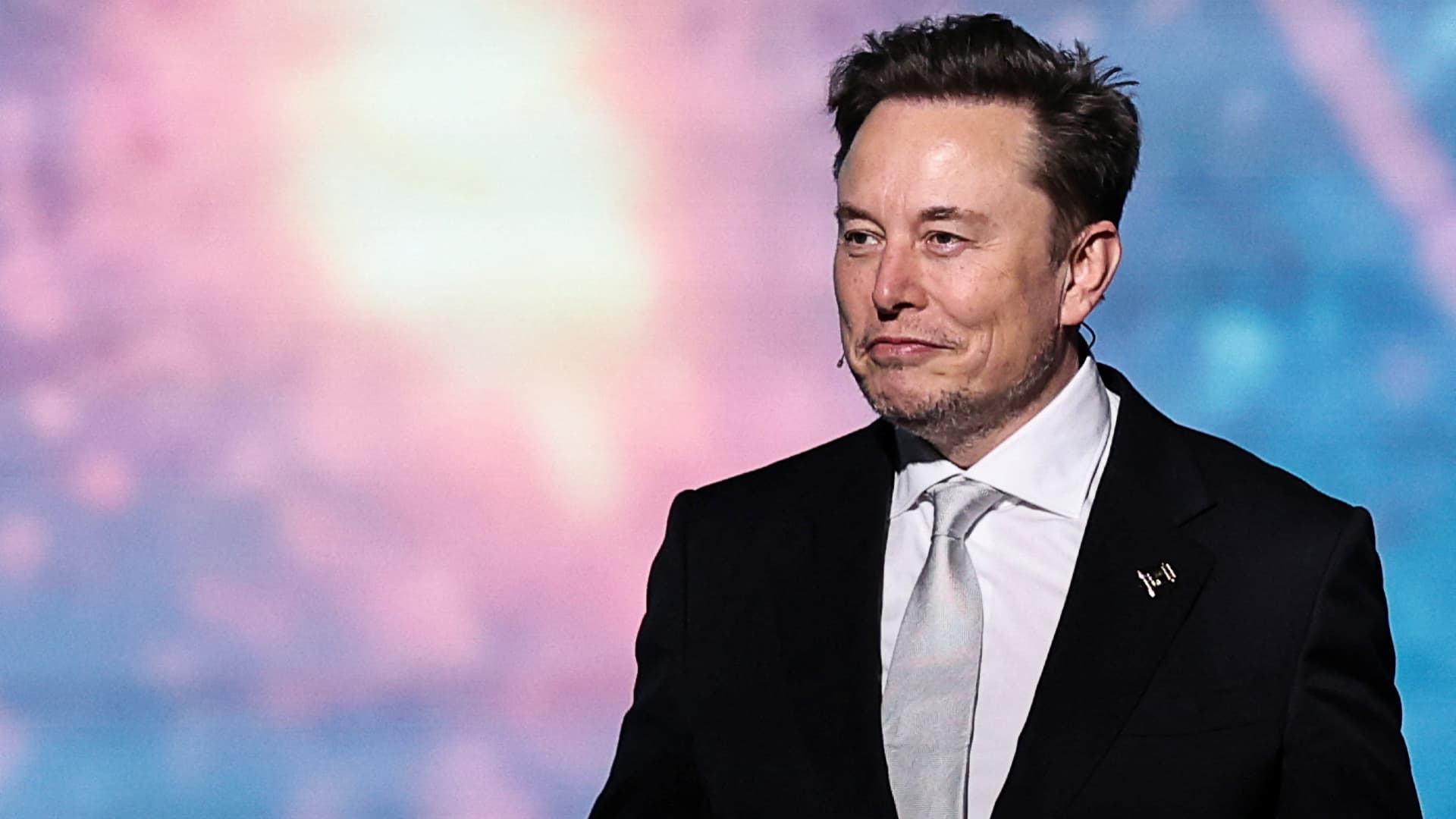
Tesla CEO Elon Musk attends the Saudi-U.S. Investment Forum, in Riyadh, Saudi Arabia, May 13, 2025.
Hamad I Mohammed | Reuters
What started off as a particularly rough year for Tesla investors is turning into quite the celebration.
Following a 36% plunge in the first quarter, the stock’s worst period since 2022, Tesla shares have rallied all the way back, reaching an all-time high of $489.48. That tops its prior intraday record of $488.54 reached almost exactly a year ago.
The stock got a spark this week after CEO Elon Musk, the world’s richest person, said Tesla has been testing driverless vehicles in Austin, Texas with no occupants on board, almost six months after launching a pilot program with safety drivers.
With the rally, Tesla’s market cap climbed to $1.63 trillion, making it the seventh-most valuable publicly traded company, behind Nvidia, Apple, Alphabet, Microsoft, Amazon and Meta, and slightly ahead of Broadcom. Musk’s net worth now sits at close to $683 billion, according to Forbes, more than $400 billion ahead of Google co-founder Larry Page, who is second on the list.
Bullish investors view the news as a sign that the company will finally make good on its longtime promise to turn its existing electric vehicles into robotaxis with a software update.
Tesla’s automated driving systems being tested in Austin are not yet widely available, and a myriad of safety related questions remain.
It’s been a rollercoaster year for Tesla, which entered the year in a seemingly favorable position due to Musk’s role in President Donald Trump’s White House, running the Department of Government Efficiency, or DOGE, an effort to dramatically downsize the federal government and slash federal regulations.
However, Musk’s work with Trump, endorsements of far-right political figures around the world, and incendiary political rhetoric sparked a consumer backlash that continues to weigh on Tesla’s brand reputation and sales.
For the first quarter, Tesla reported a 13% decrease in deliveries and a 20% plunge in automotive revenue. In the second quarter, the stock rallied but the sales decline continued, with auto revenue dropping 16%.
The second half of the year has been much stronger. In October, Tesla reported a 12% increase in third-quarter revenue as buyers in the U.S. rushed to snap up EVs and take advantage of a federal tax credit that expired at the end of September. The stock jumped 40% in the period.
Business challenges remain due to the loss of the tax credit, the ongoing backlash against Musk, and strong competition from lower-cost or more appealing EVs made by companies including BYD and Xiaomi in China and Volkswagen in Europe.
While Tesla released more affordable variants of its popular Model Y SUV and Model 3 sedans in October, those haven’t helped its U.S. or European sales so far. In the U.S., the new stripped-down options appear to be cannibalizing sales of Tesla’s higher-priced models. According to Cox Automotive, Tesla’s U.S. sales dropped in November to a four-year low.
Despite a difficult environment for EV makers in the U.S., Mizuho raised its price target on Tesla this week to $530 from $475 and kept its buy recommendation on the stock. Analysts at the firm wrote that reported improvements in Tesla’s FSD, or Full Self-Driving (Supervised) technology, “could support an accelerated expansion” of its “robotaxi fleet in Austin, San Francisco, and potentially earlier elimination of the chaperone.”
Tesla operates a Robotaxi-branded ridehailing service in Texas and California but the vehicles include drivers or human safety supervisors on board for now.
WATCH: Why speed isn’t selling EVs