



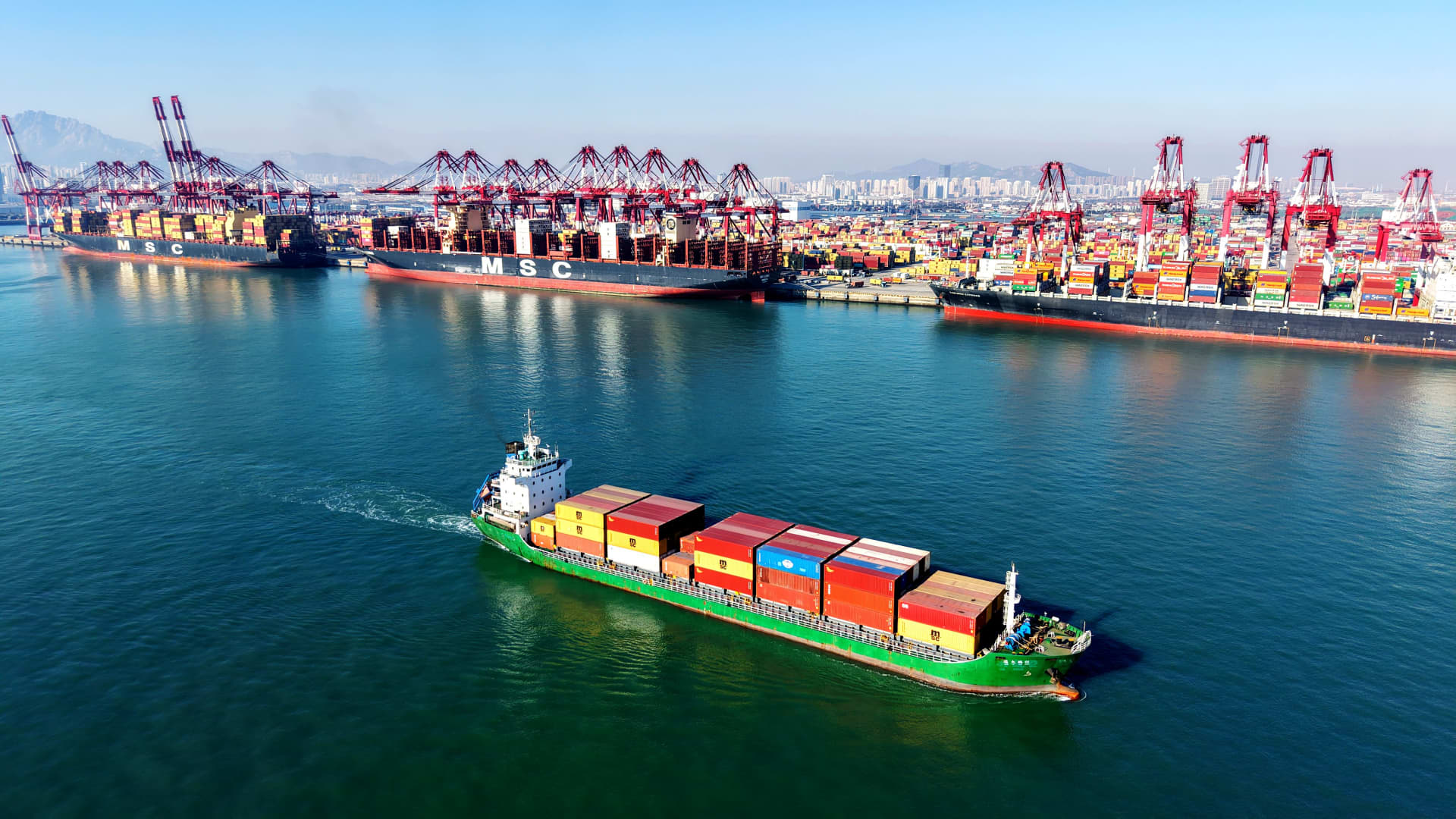
A cargo ship loaded with containers departs from Qingdao Port in Qingdao City, Shandong Province, China, on December 4, 2025.
Costfoto | Nurphoto | Getty Images
China’s exports massively beat market expectations in November as manufacturers rushed to ship out inventory on the back of a trade deal with Washington, following a meeting between the leaders of the world’s top two economies.
Outbound shipments surged 5.9% in November in U.S. dollar terms from a year earlier, China’s customs data showed Monday, topping economists’ forecast for a 3.8% growth in a Reuters poll. That growth marked a rebound from an unexpected 1.1% drop in October — the first contraction since March 2024.
Imports growth of 1.9%, however, missed expectations for a 3% rise, as Beijing renewed pledges to expand imports and work toward balancing trade amid widespread criticism against its aggressive exports.
Imports had grown just 1% in October from a year earlier as a protracted housing downturn and rising job insecurity continued to be drag on domestic consumption.

Chinese manufacturers breathed a sigh of relief after Chinese leader Xi Jinping and U.S. President reached a deal during their meeting in South Korea in late October, putting on hold a raft of restrictive measures for one year.
The two sides agreed to roll back steep tariffs on each other’s goods, export controls for critical minerals and advanced technology, with Beijing committing to buying more American soybeans and working with Washington to crack down on fentanyl flows.
Following the truce, the U.S. levies on Chinese goods remain at around 47.5% according to Peterson Institute for International Economics. Beijing tariffs on imports from the U.S. stand at around 32%
China’s factory activity shrank for an eighth month in November, an official manufacturing survey showed, with new orders staying in contraction. A private survey focused on exporters showed manufacturing activity unexpectedly fell into contraction.
Chinese policymakers are expected to meet later this month for the annual Central Economic Work Conference, to discuss economic growth target, budget and policy priorities for next year. The specific targets will not be officially announced until the “Two Sessions” meeting in March next year.
Beijing is expected to keep the 2026 growth target unchanged at “around 5%,” according to Goldman Sachs, which would require incremental policy easing early next year to ensure a growth acceleration from a likely lackluster reading in the fourth quarter of 2025.
The Wall Street bank expects Chinese authorities to lift the augmented fiscal deficit ceiling by 1 percentage point of GDP, cut policy rates by a total of 20 basis points and step up stimulus measures to rein in the housing slump.

Subscribe now
The strengthening yuan in recent weeks has not appeared to stem the flow of China’s exports. The offshore yuan has strengthened nearly 5% since April to 7.0669 per dollar at market open on Monday, according to LSEG data.
Despite a steady 5% annual GDP growth since 2023, China “urgently needs to curb its export dependence and pivot towards domestic consumption to ensure sustainable expansion,” Weijian Shan, chief executive of private equity firm PAG, said in an opinion piece last month.
A stronger yuan could boost consumption’s contribution to economic growth to the 2023 level of 86% from currently 53%, as it would lower costs of imports and enhance household purchasing power, Shan added.
This is breaking news. Please refresh for updates.