





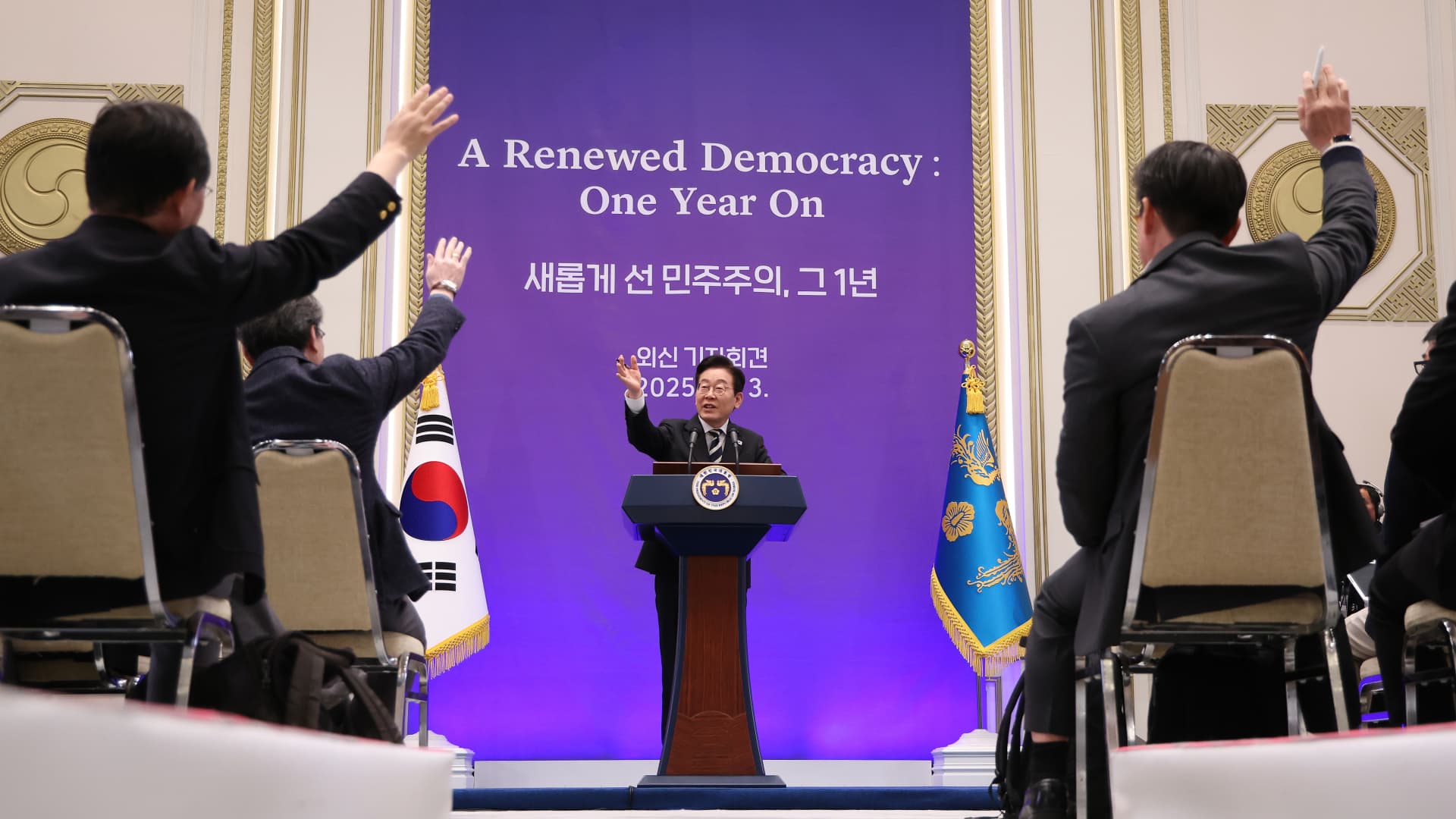
SEOUL, SOUTH KOREA – DECEMBER 03: President Lee Jae Myung speaks during a press conference to mark the first anniversary of former President Yoon Suk Yeol’s brief imposition of martial law, at Yeongbingwan of Blue House on December 03, 2025 in Seoul, South Korea. A year has passed since then-President Yoon Suk Yeol declared a state of emergency martial law, stunning Korea and setting off a political crisis that continues to reverberate today. (Photo by Chung Sung-Jun/Getty Images)
Chung Sung-jun | Getty Images News | Getty Images
South Korean President Lee Jae Myung vowed “strict accountability” for the perpetrators behind last year’s failed martial law attempt by former leader Yoon Suk Yeol, calling the upheaval a test of the country’s democratic resilience.
Speaking in a special address to the nation, Lee described the events of Dec. 3 as a “revolution of light,” according to an English translation by Ariang News, and said that this “revolution” was incomplete.
He added that investigations and trials tied to the insurrection remain underway.
The former president is currently on trial for insurrection, while prosecutors have reportedly sought a 15-year prison term for former prime minister Han Duck-soo.
Other senior officials, including Yoon’s defence minister and the former head of the National Intelligence Service, have also been arrested in connection with the attempt to impose military rule.
The speech marked one year since Yoon abruptly declared martial law, the first such move in Asia’s fourth-largest economy since 1980.
A television screen shows a news broadcasting of South Korean President Yoon Suk Yeol delivering a speech on emergency martial law, in Goyang, northwest of Seoul, on December 3, 2024.
Jung Yeon-je | Afp | Getty Images
Lee labeled the martial law attempt by Yoon a “self-coup” and said that “those who destroyed the constitutional order for personal ambition and even sought to provoke war must face judgment, to build a country where no one can ever again dream of a coup.”
The South Korean president also commended the South Korean people in his speech, saying that they had overcome an “unprecedented democratic crisis” peacefully, and were “fully deserving of the Nobel Peace Prize.”
When asked by the press if he would nominate the South Korean people for the honour, Lee clarified that this was merely his personal opinion, but hoped that his comment would be a “trigger [for] people’s discussions.”
Martial law attempt
The crisis began on Dec. 3, 2024, when Yoon suddenly declared martial law in a late-night address and accused Lee’s Democratic Party of Korea of engaging in “anti-state activities” and colluding with “North Korean communists.”
Yoon ordered troops to the country’s National Assembly, where soldiers blocked access and clashed with protesters and lawmakers as special forces attempted to enter the chamber.
But within three hours, the martial law order was overturned after 190 of the 300 National Assembly lawmakers — including Lee — managed to gather in the chamber and unanimously overturned the decree. Yoon eventually lifted martial law about six hours after his announcement.
Soldiers try to enter the National Assembly building in Seoul on December 4 2024, after South Korea President Yoon Suk Yeol declared martial law. South Korea’s President Yoon Suk Yeol on December 3 declared martial law, accusing the opposition of being “anti-state forces” and saying he was acting to protect the country from “threats” posed by the North.
Jung Yeon-je | Afp | Getty Images
South Korea then spiraled into weeks of political turmoil. Yoon was impeached on Dec. 14, making then-Prime Minister Han the acting president. Han was also impeached on Dec. 27 and replaced by then-Deputy Prime Minister Choi Sang-mok.
The country’s Constitutional Court then reinstated Han in March, making him acting president again until the court finally removed Yoon from office on April 4. Yoon was later arrested and charged with insurrection, an offense that carries the maximum penalty of death.