



A Federal Reserve split over where its priorities should lie cut its key interest rate Wednesday, but signaled a tougher road ahead for further reductions.
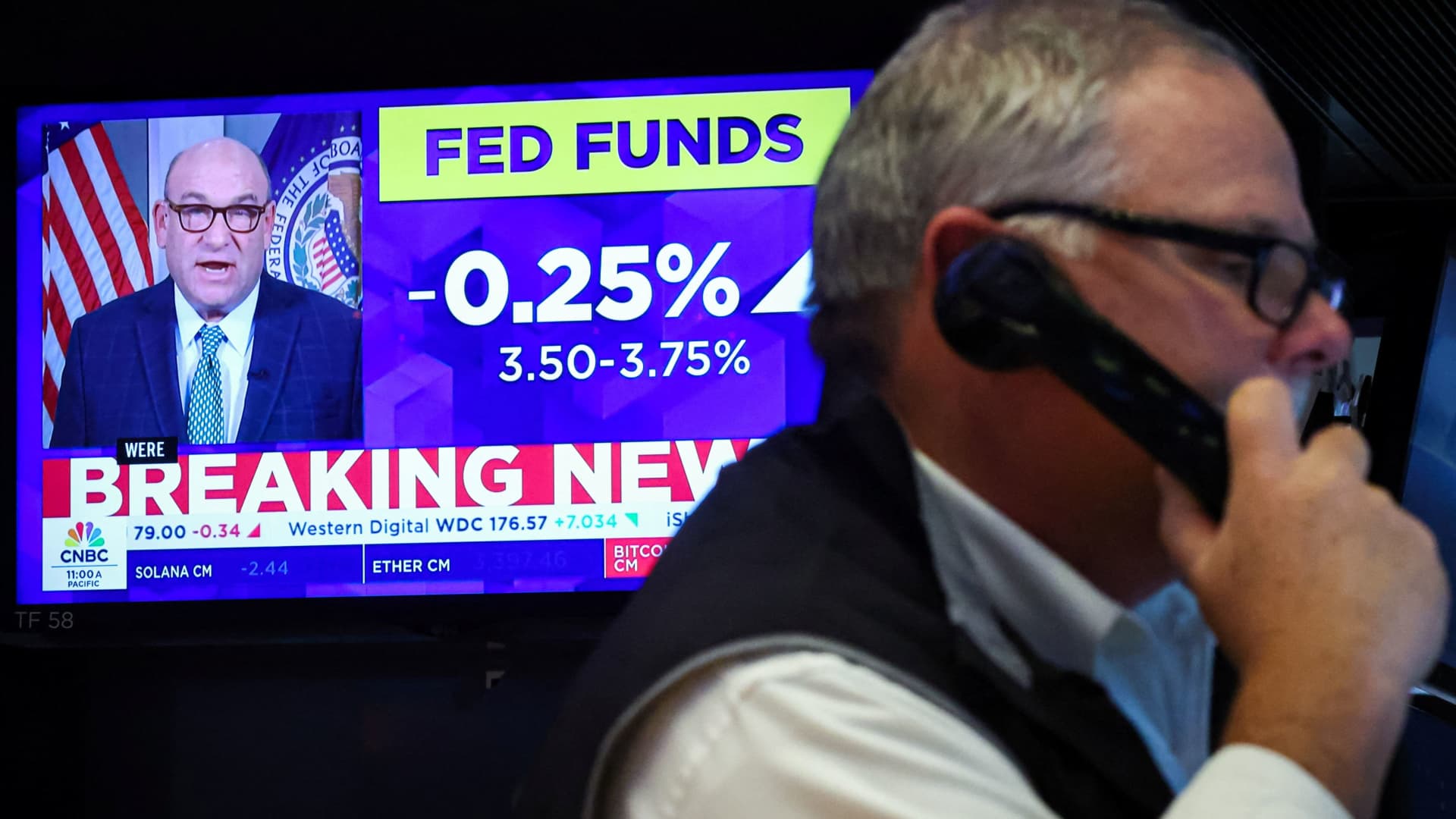
Fulfilling expectations of a “hawkish cut,” the central bank’s Federal Open Market Committee lowered its key overnight borrowing rate by a quarter percentage point, putting it in a range between 3.5%-3.75%.
However, the move carried caution flags about where policy is headed from here and featured “no” votes from three members, which hasn’t happened since September 2019.
The 9-3 vote again featured hawkish and dovish dissents – Governor Stephen Miran favored a steeper half-point reduction while regional Presidents Jeffrey Schmid of Kansas City and Austan Goolsbee of Chicago backed holding the line. In Fed parlance, hawks are generally more concerned about inflation and favor higher rates while doves focus on supporting the labor market and want lower rates.
This was the third consecutive “no” vote from Miran, who leaves the Fed in January, and the second straight from Schmid. The previous three-dissent meeting also featured a 2-1 divide from members conflicted between the need for tighter and looser monetary policy.
The post-meeting rate statement repurposed language from the FOMC meeting a year ago.
“In considering the extent and timing of additional adjustments to the target range for the federal funds rate, the Committee will carefully assess incoming data, the evolving outlook, and the balance of risks,” the statement said.
When the language was used in December 2024, it signaled that the committee likely was done cutting for the time being. The FOMC then did not approve any reductions until the September 2025 meeting.
With a third consecutive cut now made, the focus turns to where the FOMC heads from here, with little room for additional reductions.
The closely watched “dot plot” of individual officials’ expectations on rates indicated just one cut in 2026 and another in 2027 before the federal funds rate hits a longer-run target around 3%. Those projections were unchanged from the September update, but the plot reflected divisions within the committee about where rates should head.
Along with the two “no” dovish votes on the rate cut, four other nonvoting meeting participants registered “soft dissents” indicating that they did not go along with the decision. Seven officials also indicated they want no cuts next year. FOMC meetings feature 19 participants among the governors and regional presidents, 12 of whom vote.
On the economy, the committee raised its collective view of gross domestic product growth for 2026, boosting its September projection up by half a percentage point, to 2.3%. The committee continues to expect inflation to hold above its 2% target until 2028.
On inflation, prices remain stubbornly high, with the Fed’s preferred gauge putting the annual rate at 2.8% in September, the most recent month for which data is available. While that’s considerably off the peaks of a few years ago, it’s still well north of the central bank’s 2% target.
In addition to the rate decision, the Fed also announced it will resume buying Treasury securities, following up on an announcement at the October meeting that it would halt its balance sheet runoff this month. The move comes amid concerns about pressures in overnight funding markets.
The central bank will start by buying $40 billion in Treasury, beginning Friday. From there, purchases are expected to “remain elevated for a few months” and then likely will be “significantly reduced.”
The moves come at a sensitive time for the Fed.
As he seeks to maintain consensus among policymakers, Chair Jerome Powell is nearing the end of his second term as chair. He has just three meetings left before he makes way for President Donald Trump‘s nominee.
Trump has signaled he will litmus test his choice, using a preference for lower rates as a barometer, rather than someone committed to the Fed’s dual mandate of stable prices and full employment. The president told reporters Tuesday evening he expects to make a choice soon.
Predictions markets are betting the nominee will be National Economic Council Director Kevin Hassett, who is viewed in some corners of the financial markets as a Fed chair who will seek to do Trump’s bidding. As of Wednesday morning, Kalshi had Hassett’s chances of getting the nod at 72%, with former Fed Governor Kevin Warsh and current Governor Christopher Waller trailing far behind.
Fed officials have had to operate in an environment where much of the official data they use in decision-making either has been trickling in well behind schedule or missing entirely, due to the government shutdown that lasted about six weeks, until Nov. 12.
What data they have seen has indicated a low-hire, low-fire labor market, with employers reluctant both to add to payrolls or to lay off large numbers of workers. However, recent signs from unofficial data point to heavier jobs reductions to come, with announced layoffs through November topping 1.1 million, according to employment placement firm Challenger, Gray & Christmas.