



This report is from this week’s CNBC’s UK Exchange newsletter. Like what you see? You can subscribe here.
The dispatch
Lovers of ice cream brands like Magnum, Cornetto, Carte D’Or, Ben & Jerry’s, Breyers and Wall’s can now own shares in them directly following Monday’s demerger of The Magnum Ice Cream Company (TMICC) from former parent Unilever.
In one of the splashiest stock market events of 2025, shares of TMICC debuted on Amsterdam’s Euronext, and there are also secondary listings in London and New York — where Peter ter Kulve, the chief executive, will ring the opening bell today. (He’ll also be live on CNBC’s Squawk on the Street at 3 p.m. GMT/10 a.m. ET.)
The listing, Euronext’s largest this year, valued TMICC, the world’s biggest ice cream producer, at 7.8 billion euros ($9.1 billion).
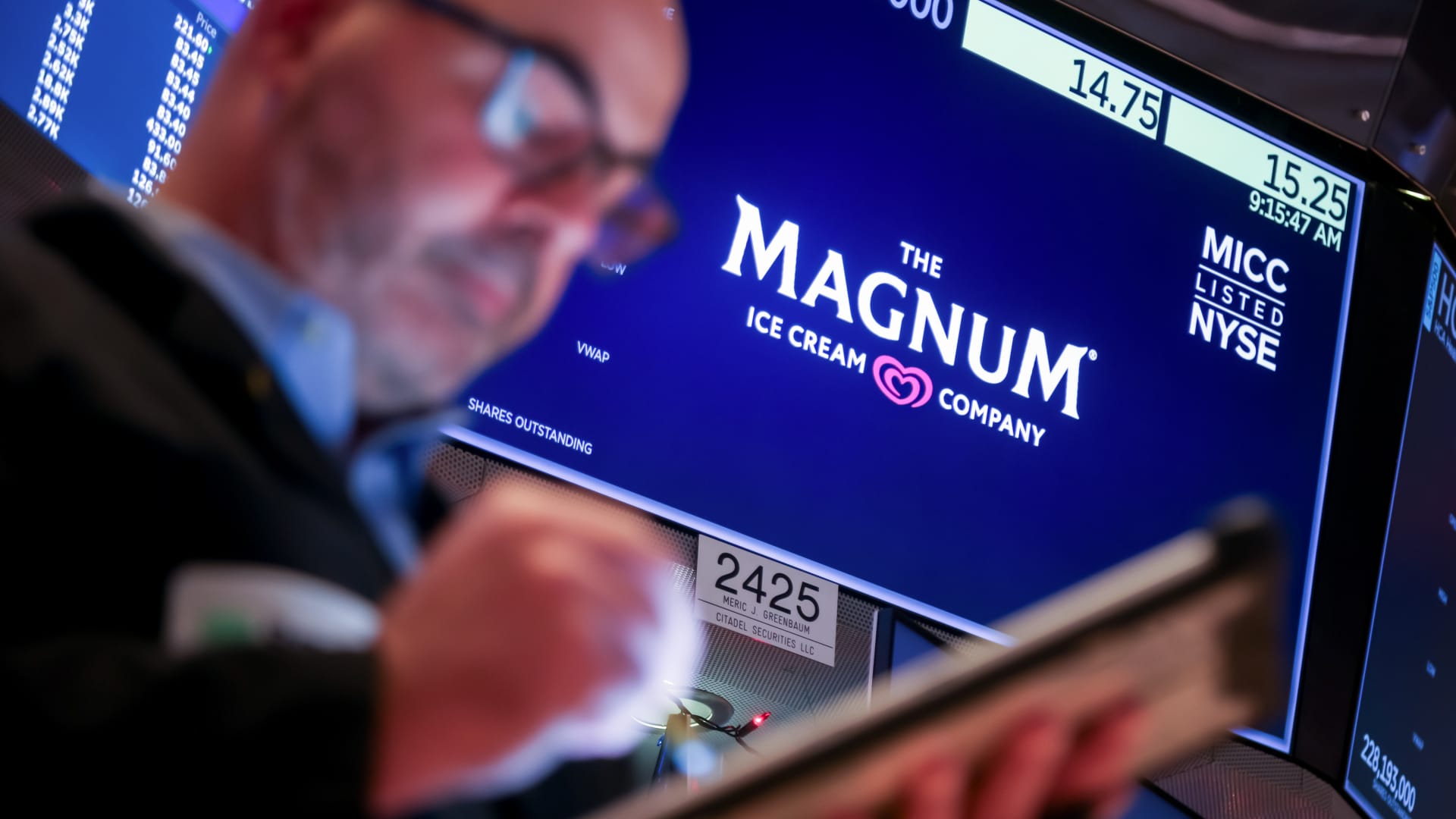
Magnum Ice Cream Company signage as a trader works on the floor of the New York Stock Exchange (NYSE) in New York, US, on Monday, Dec. 8, 2025.
Michael Nagle | Bloomberg | Getty Images
But what are the prospects for the newly demerged business and for Unilever itself?
Neither question is easily answered.
First: TMICC, where even the share price prospects are unpredictable in the short term. The company itself has warned that, as it will not qualify for indices such as the FTSE 100, there could be initial selling by tracker funds unable to hold the stock. The lack of a dividend in 2026 will also deter some investors.
Unilever and its banking advisors sought to address this by setting a low reference price for TMICC shares and, accordingly, some bargain hunters may step in. And it is cheap: including debt, TMICC is worth little more than the next-biggest player in the $87-billion global ice cream market, Froneri, a British-based joint venture between Nestle and PAI Partners, the French private equity firm. It has an 11% global market share compared with TMICC’s 21%.
In terms of trading prospects, there are also headwinds, most obviously the growing popularity of weight-loss drugs. Ahead of the demerger, ter Kulve played down these risks, arguing that for years TMICC has evolved its portfolio to include more products with reduced sugar, higher amounts of protein or in which portions can be controlled. Examples include Breyers CarbSmart ice cream, which is higher in protein, or Ben & Jerry’s move from pint cartons to ice cream on sticks. The CEO is targeting medium-term organic annual sales growth of 3%-5%, compared with the long-term average of 3% achieved under Unilever.
There may also be opportunities for TMICC, as a more focused business, to increase investments in its supply chain, where there was little overlap with Unilever’s other businesses, potentially leaving it neglected. That goes for the investment story more broadly.
As Chris Beckett, consumer staples analyst at the wealth manager Quilter Cheviot, put it: “While Magnum hasn’t thrived under Unilever’s ownership, there is some hope that the revitalised management team — albeit predominantly made up of ex-Unilever employees — will produce a better operating performance.”
There is another potential thorn in ter Kulve’s side. Ben & Jerry’s, bought in April 2000 from founders Ben Cohen and Jerry Greenfield, has been increasingly problematic.
In 2021, the pair briefly stopped Unilever from selling the product in Israeli settlements in the West Bank, before the ensuing backlash prompted Unilever to sell the brand’s Israeli arm to a local licensee. Greenfield left the business in September this year while, last month, TMICC said that Anuradha Mittal, chair of the Ben & Jerry’s independent board, “no longer meets the criteria” to serve, without giving more details.
In a typical piece of Dutch plain speaking, ter Kulve told the Financial Times on Monday the pair should “hand over to a new generation.”
He warned that TMICC might no longer continue contributing to the Ben & Jerry’s charitable foundation unless corporate governance failures identified in a recent audit were addressed.
The spat is another reason why Unilever will be happy to offload TMICC — where returns have been lower than in its other businesses, even though it is for now retaining a 19.9% stake, which will be sold over the next five years.
A long overdue re-rating?
The bigger question, though, is whether this latest reshaping of Unilever will lead to a re-rating by the market. I have been covering this company’s fortunes for more than 30 years and have witnessed countless attempts to achieve this.
Coming in, there were the purchases in 2000 of Ben & Jerry’s, Slim-Fast (since sold) and Best Foods, which brought Unilever the Hellmann’s brand; the ill-fated $1 billion acquisition of Dollar Shave Club in 2016; and the 2019 acquisition of the healthy snacking brand Graze, again since sold.
Going out of the door have been Unilever’s speciality chemicals business, sold to ICI for £5 billion ($6.66 billion) in 1997; its spreads business — including the Flora brand — which was sold to KKR for 6.7 billion euros in 2017 and, more recently, the £3.8 billion sale in 2021 of Unilever’s black tea business, owner of iconic brands such as PG Tips and Liptons, to the private equity firm CVC.
Not to mention a whole host of smaller disposals, such as Ambrosia creamed rice and Brown & Polson cornflour, both sold to Premier Foods in 2003 and Birds Eye frozen food, offloaded to Permira in 2006.
In between, there have been numerous strategic overhauls.
Terry Smith, whose investment firm Fundsmith is one of Unilever’s top 10 shareholders, noted last year they have included 2010’s Unilever Sustainable Living Plan, 2016’s Connected 4 Growth and 2022’s Unilever Compass Strategy for Sustainable Growth.
Yet none mattered as much as the move, five years ago, to a single company structure that ended the 90-year old arrangement of two parents — the British Unilever plc and the Dutch Unilever NV — and provided more corporate flexibility.
The demerger of TMICC feels almost as fundamental.
At a stroke, it raises the quality of Unilever’s earnings, leaving it even more focused on the two dozen or so brands that account for three-quarters of its annual sales. Of these, a dozen have annual sales exceeding 1 billion euros, including Dove, Omo and Domestos.
As Fernando Fernandez, the newish chief executive and a man plainly in a hurry, noted on LinkedIn on Monday: “For Unilever, this milestone allows us to keep sharpening our focus in building a portfolio of power brands with unparalleled geographical footprint and superior growth prospects.”
Notably, just two of these 1-billion-euro brands — Knorr and Hellmann’s — reside in its food division. Other food brands, including Marmite, Colman’s mustard and Bovril, are already said to be on the block. Should the spin-off of TMICC not result in a re-rating, it would be no surprise if Unilever became a pure beauty and well-being, personal care and home care business, with its entire foods division a distant memory.
Top TV picks on CNBC


James Edwardes Jones, managing director at RBC Capital Markets, discusses Unilever’s decision making for spinning off its ice cream business.

Visa is relocating its European headquarters from Paddington to London’s Canary Wharf financial district — leasing a 15-year, 300,000-square-foot space at One Canada Square from 2028.

Huge fiscal stimulus and low rates are going to lift demand and growth globally, but protectionism and geopolitical unrest will raise inflation, says Wellington Management’s Paul Skinner.
— Katrina Bishop
Need to know
The UK wants to unlock more nuclear energy. Britain once had more nuclear power stations than the U.S., USSR and France combined. In 2023, the country generated just 14% of its power from nuclear — it wants to increase that proportion to 25% by 2050.
UK’s Canary Wharf grows more attractive to companies. Once emptied by the coronavirus pandemic, London’s answer to Wall Street is seeing a resurgence of interest. Visa is moving its European headquarters there, while JPMorgan plans to build a new tower in the area.
[PRO] A UK travel company that could see its share price multiply. Alyx Wood, co-founder and chief investment officer of Kernow Asset Management — a contrarian stock picker — said the stock is “materially undervalued,” and gives it an upside of 468% over the next five years.
— Yeo Boon Ping, Katrina Bishop
Quote of the week
We should get, starting at the December [BoE] meeting, a much clearer route to rate cuts in the U.K. … The U.K. market has not done badly this year, but those rate cuts actually give a decent story for us to look forward into next year.
— George Godber, fund manager, Polar Capital UK Value Opportunities Fund
In the markets
London-listed stocks reversed course this week, with the FTSE 100 losing 0.62% since last Wednesday. The index closed 0.03% lower at 9642.01 on Tuesday, pulling back from reaching a landmark 10,000 points.
Shares of WPP rallied 6.3% on Tuesday after the advertising and communications giant landed a lucrative contract to run the U.K. government’s ad strategy. The four-year deal, which is reportedly worth up to £2 billion ($2.7 billion), will see WPP-owned agency Wavemaker oversee a wide range of media and advertising campaigns for the government.
Meanwhile, Unilever was another one of the FTSE’s key risers on Tuesday, rising 3.6% as its ice cream spin-off The Magnum Ice Cream Company debuted on stock exchanges in London, New York and Amsterdam on Monday.
The British pound was marginally lower against the greenback over the week, trading at $1.3296 on Tuesday, compared with last Wednesday’s $1.3352.
Yields on the U.K. government’s benchmark 10-year bonds — also known as gilts — rose over the same period, up to 4.511% from 4.480%.


The performance of the Financial Times Stock Exchange 100 Index over the past year.
— Hugh Leask
Coming up
Dec. 12: U.K. GDP monthly estimate and trade data for October
Dec. 15: Rightmove House Price Index for December
Dec. 16: Unemployment data for October
— Katrina Bishop