





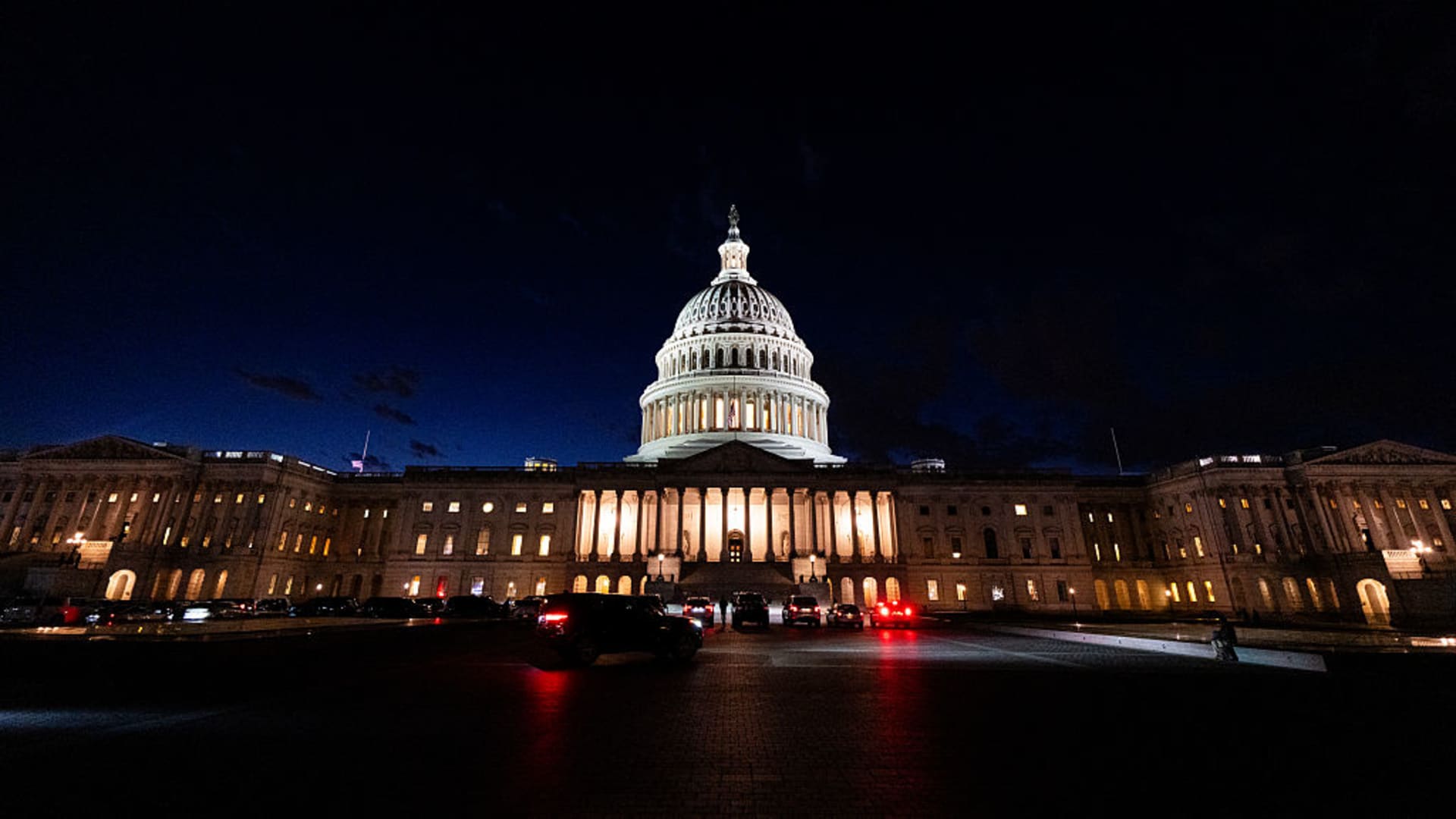
The U.S. Capitol dome is illuminated as the House of Representatives returns to Washington to vote to reopen the government Wednesday, Nov. 12, 2025.
Bill Clark | CQ-Roll Call, Inc. | Getty Images
Private markets could get an influx of capital and investors under legislation approved by the House on Thursday
The package of capital-formation bills, called the INVEST Act, passed the House 302 to 123. Eighty-seven Democrats joined every Republican in the House to support the bill.
The wide-ranging package of legislation would allow more investors access to private markets. Lawmakers say the measure will help more companies go public and increase capital formation for startups.
Instead of only wealth or income determining who can be an accredited investor, investors could become accredited by taking an exam approved by the Securities and Exchange Commission.
House Financial Services Chairman French Hill, R-Ark., said the bill was needed in part because of the decrease in the number of public companies in America.
“We make it easier to be a public company in America,” Hill said on the House floor during debate on the bill. “
“We make it easier, if you have a great idea, to crowdsource that idea, to raise money from friends and family. And we make it easier, if you’re an individual investor, to have other opportunities in which to invest.”
The bill also would lift the cap for how much venture capital firms can raise, and how many people can invest, before they are subject to stricter disclosure and compliance regulations.
The bill increases the number of investors to 500 from 250, and increases funds to $50 million from $10 million.
It also would become easier for venture capital firms to invest in each other — a change lawmakers say will help more funds reach companies in places like the Midwest and the South.
Rep. Bill Huizenga, R-Mich., said that unicorn companies — privately held startups with a valuation of $1 billion or more — used to be rare. Now, he said there are “herds of unicorns” which limit investing opportunities for the public.
“We’re trying to make sure that this is open and accessible to folks, and I think that’s going to be a healthier approach for both the public markets and the private markets,” Huizenga said.
The bill now heads to the Senate, where making capital formation easier is on Banking Committee Chair Tim Scott’s to-do list.
It is not clear if the Senate will take up the House package, move individual pieces of it, or try to do its own bill.