






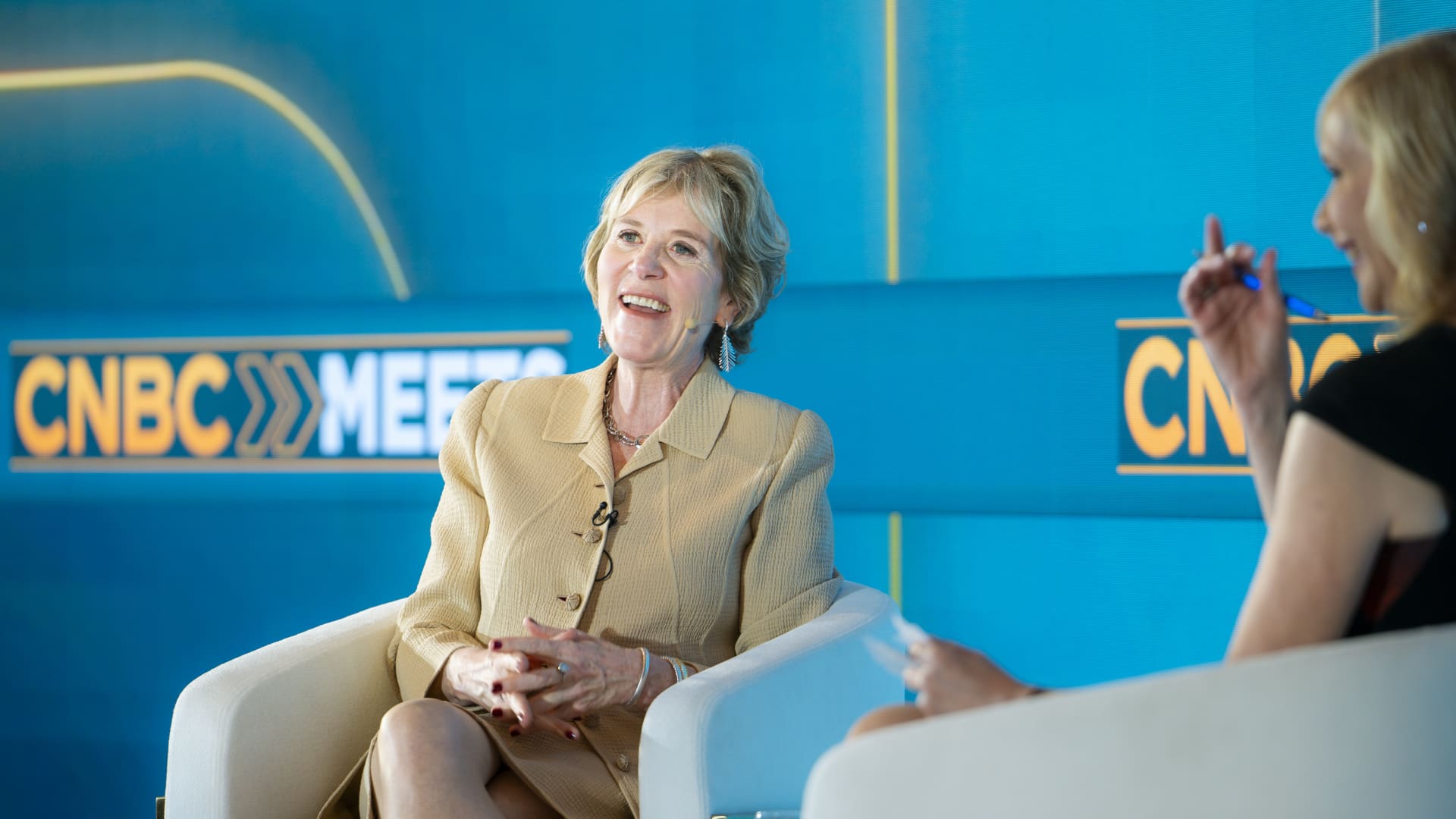
Hannah Rothschild during a special recording of “CNBC Meets: Legacies” at a private banking event organized by United Overseas Bank in Singapore on Nov. 19.
CNBC
Dame Hannah Rothschild has long understood that being born into one of Europe’s most storied dynasties confers not only privilege but a deep sense of duty, as she works to guide a centuries-old family network into its next chapter.
At the age of nine, the eldest daughter of the late British financier Jacob Rothschild started sitting at the dining table with visiting business figures, listening and absorbing conversations about subjects such as the Japanese economy.
The intellectual atmosphere of her childhood was shaped by regular guests, including ballet legend Rudolf Nureyev, painter Lucian Freud and philosopher Isaiah Berlin.
I think it is fair to say that the name Rothschild walks into the room before you do. It comes with enormous history, quite a lot of gravitas, quite a lot of conspiracy theories, and quite a lot of responsibility.
Hannah Rothschild
Chair of the Rothschild Foundation
Now, at the age of 63, Hannah sits on the boards of RIT Capital Partners, the former Rothschild Investment Trust, as well as Windmill Hill Asset Management, while serving as a director at Five Arrows, the alternative assets arm of Rothschild & Co.
The author and filmmaker also chairs the Rothschild and the Yad Hanadiv foundations, long-standing family institutions.
“We were born to feel it was an incredible gift and an accident to be born with this privilege… It is our responsibility to make the most of it,” said Hannah during a special recording of “CNBC Meets: Legacies” at a private banking event in Singapore organized by United Overseas Bank.


While the seventh-generation scion admitted feeling nervous about the weight of that responsibility, Hannah told CNBC’s Tania Bryer she feels proud to have proved her worth “both inside the family and outside the family” through hard work.
“I think it is fair to say that the name Rothschild walks into the room before you do. It comes with enormous history, quite a lot of gravitas, quite a lot of conspiracy theories, and quite a lot of responsibility,” she added.
Philanthropy at the heart
Hannah Mary Rothschild was born in London in 1962 and grew up with her sisters, Beth and Emily, and her brother, Nathaniel, who is the 5th Baron Rothschild. Her father, Jacob, the 4th Baron Rothschild, was known for his work in finance, the arts and philanthropy until his death early last year.
While she didn’t join the family business after her studies, she remained tied to the charitable work her family supported.
“From a very early age, we were involved in our family charities,” she said.
At the UK-based Rothschild Foundation, which she now chairs, she described the three principal missions as arts and culture, local society and the environment. “What we tend to support are existing charities and existing organizations, because they’re much more embedded into society.”
Exterior of Waddesdon Manor, a country house in the village of Waddesdon. Built in the Neo-Renaissance style of a French chateau.
Universal History Archive | Universal Images Group | Getty Images
One of the foundation’s main activities is the conservation of Waddesdon Manor in Buckinghamshire, a French Renaissance-style château with a world-class art collection and landscaped gardens that attracts nearly 400,000 visitors a year.
“We want, basically, people to understand what the collection is and why it matters and why history matters,” she said.
As for Yad Hanadiv, which operates in Israel, the priority is devoting more resources to education, aiming to strengthen the foundations of an open, vibrant, democratic society. Yad Hanadiv’s programs include promoting equal educational and vocational opportunities for the country’s Arab community.
“When my forebears set it up, we set it up for everybody, regardless of their religion, of their creed,” she said. “And that informs everything that we do.”
Building a lasting dynasty
On the investment side, Hannah said she leaves decisions at RIT and other entities to senior executives. In her personal portfolio, she holds 10% in gold and 1% in cryptocurrencies.
“I don’t really understand crypto… I still think there’s an Emperor’s New Clothes aspect of it,” she said, although she added she didn’t want to willfully ignore a trend that is probably here to stay.
Asked about the Rothschilds’ enduring success over more than two centuries, Hannah said the simple rule that bound family members was “togetherness.” Mayer Amschel Rothschild, who founded the business empire in the 1760s, would later send his five sons to the different major capitals of Europe from their base in Frankfurt, creating an early international banking network through constant communication.
Hannah Rothschild during a special recording of “CNBC Meets: Legacies” at a private banking event organized by United Overseas Bank in Singapore on Nov. 19.
CNBC
While the family’s business empire relies heavily on outside expertise, “we also believe that there is a kind of code amongst a family of discretion, of thoughtfulness, which I think is a kind of principle,” she said.
Networking, she added, is also important. The earlier generations of the Rothschilds understood that business isn’t just done in a boardroom, but also in a “ballroom.”
“Business is who you know, how you interact with people. So they realized that they had to become more sophisticated, and they set about making themselves more sophisticated,” she said.
She shared an anecdote about fox hunting, which was a key activity for socializing with local landowners and a natural path for the family to demonstrate its social standing. After the Rothschilds were excluded from some hunting parties, the family bought land and organized their own events.
Steering the next generation
Hannah described the most challenging aspect of running a family organization as managing sensitivities, as people have different ways of looking at things.
“It’s a constant readjustment, legacy and succession… I think that as people change, you have to adjust the legacy, and you have to adjust the succession,” she said.
As the most senior Rothschild in her generation, she sees her role as educating the next generation and making them feel that they are part of the family and have a role to play.
“My hopes for the Rothschild legacy are that we continue to use our tremendous privilege, the money we’ve made, the good name that we’ve fostered to help other people, way beyond our own family.”